Spatial Audio & Immersive Music for Bass House: Complete Guide
Spatial9 Team · · Updated · 13 min read
Part of the series Spatial audio and immersive music by genre.
Key takeaways
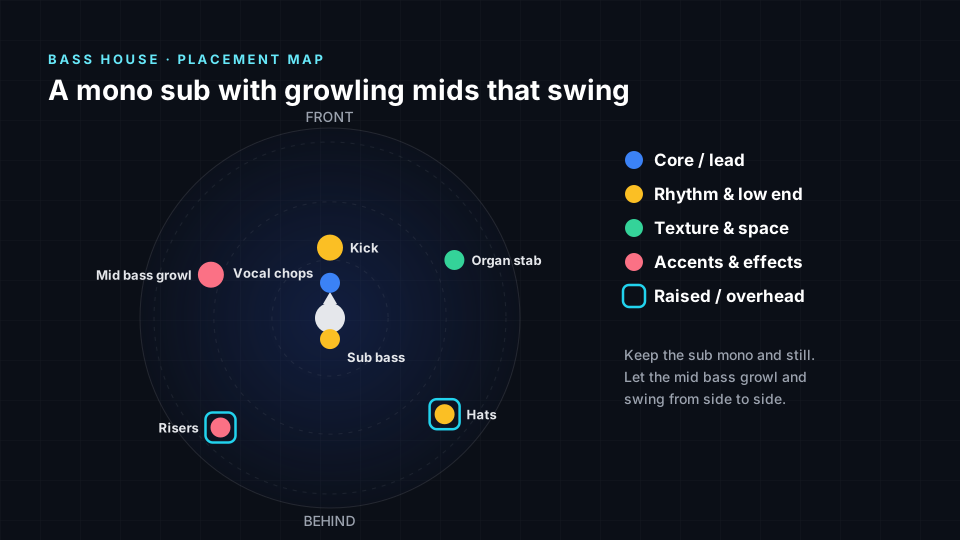
- In a spatial bass house mix the kick, sub bass and vocal chops stay centred, while the growling mid bass, organ stabs, hats and risers are placed around the listener.
- Bass house works best when the sub and the mid bass are split: the sub stays mono in the centre for weight, while the growling mid bass moves from side to side to carry the character of the drop.
- Frequencies below roughly 80 to 100 Hz give the ear very little sense of direction, so a centred bass house sub loses no immersion and stays heavy on every system.
- The bass house immersion profile scores width 4, height 3, movement 4, low-end focus 5 and space 2 out of 5.
Bass house is house music with the low end turned into the lead instrument. It grew out of the UK's speed garage and bassline scenes and came back into clubs in the 2010s with a harder, more distorted edge. The formula is direct: a punchy four-to-the-floor kick, a deep sub, a growling or wobbling mid bass that carries the hook, chopped vocal phrases and the occasional speed garage organ stab. In stereo, all that bass energy piles into the middle and the drop can feel like one loud block. Spatial audio splits the weight from the character, so the sub stays solid while the growl gets room to move. This guide covers how spatial audio for bass house works, where to place each element and how to make an immersive bass house mix. For the basics, see what spatial audio is.
Why bass house is ideal for spatial audio
A bass house drop usually layers two basses: a clean sub for weight and a distorted mid bass for attitude. In stereo they compete for the same speakers, and widening the whole bass smears the low end. In an immersive mix you can treat them as two different instruments: one locked in the centre, one free to swing.
The rule: a still sub, a moving growl. The weight never moves, while the character dances across the room.
Immersive music for bass house: what listeners hear
- A sub that hits the chest. The deepest bass stays centred, mono and heavy.
- A growl that moves. The mid bass swings across the front on every drop.
- Chops that cut through. Vocal chops stay tight and close in the middle.
- Tension from above. Risers and hats climb overhead before the drop lands.
Where to place each element in a bass house mix
| Element | Position | Height | Why it works |
|---|---|---|---|
| Kick | Front centre | Ear level | Hard four-to-the-floor punch |
| Sub bass | Centre | Ear level | Pure weight, no direction needed |
| Mid bass growl | Left, moving | Ear level | The character of the drop, swung across the front |
| Vocal chops | Front centre | Ear level | Tight, rhythmic hook |
| Organ stab | Front right | Ear level | Speed garage colour that answers the bass |
| Hats | Behind right | Raised | Bright drive above the groove |
| Risers | Behind left | Raised | Tension into the drop |
The psychoacoustics behind Bass House placement
Every position in the table above follows how the ear and brain locate sound. Here is the reason behind the main choices for Bass House.
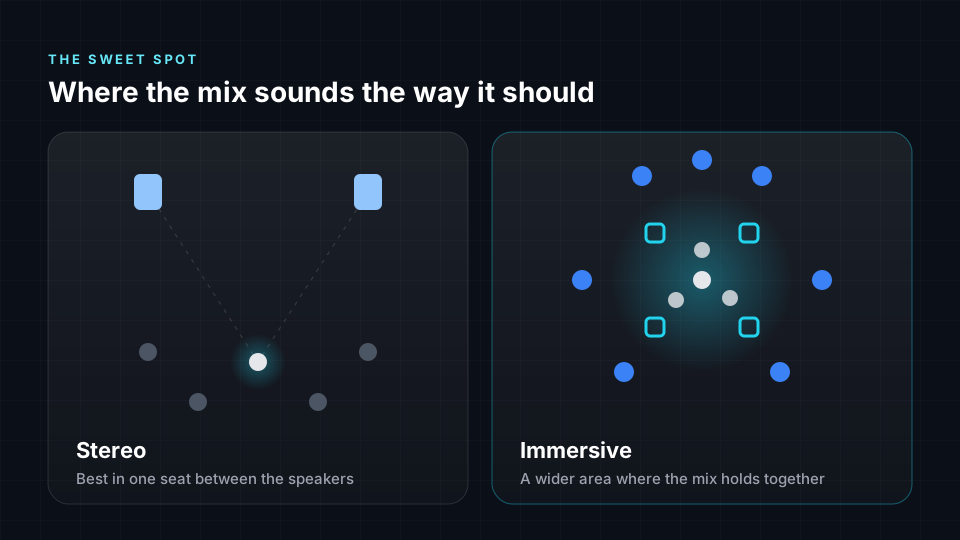
- Sub and kick stay centred. Below roughly 80 to 100 Hz the brain gets very little usable direction from a sound, which is why one subwoofer can support a whole speaker array. The bass house sub sits in that range, so centring it costs nothing and keeps the drop equally heavy for every listener.
- Mid bass moves, sub stays. The growl lives in the mids and upper mids, where the ear locates sound well. That is why the character can travel while the weight stays still. The brain also groups sounds by where they come from, an effect described in auditory scene analysis, so a moving growl is heard as its own voice rather than part of the sub.
- Organ stab opposite the growl. Sounds that share a frequency range mask each other less when they come from different directions. This is spatial release from masking. Stabs and growls fight in the same mid band, so opposite sides let both punch through.
- Risers raised behind. Listeners are biased towards hearing rising tones as closer and more urgent than falling ones. A riser that climbs from behind and above uses that bias to make the build feel larger before the sub and kick return.
The immersion profile for bass house
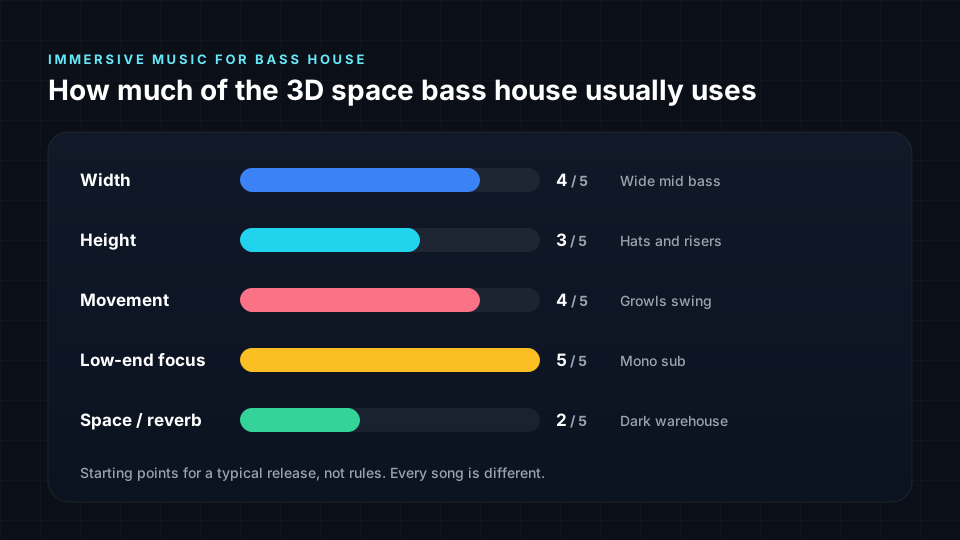
Low-end focus is at maximum because the sub and kick carry the track. Width and movement are high because the mid bass swings across the room. Space stays low: bass house hits hardest when it is dry and close, like a dark warehouse with a loud system.
Tips for an immersive bass house mix
- Split the bass. Treat sub and mid bass as two separate parts with two separate positions.
- Keep the sub mono. It should be identical from every direction.
- Move the growl in time. Sync side-to-side motion to the bar so it grooves rather than wanders.
- Keep vocal chops dry. They are rhythm, not atmosphere.
- Use height for the build only. Let risers rise, then pull everything back to ear level on the drop.
Dolby Atmos and object-based mixing for bass house
Dolby Atmos mixes bass house as a channel bed plus objects placed anywhere in the room. The bed handles the heavy low end, while objects allow the mid bass and synths to move freely. Most listeners will hear the result on headphones through binaural rendering on Apple Music, Tidal or Amazon Music. Spatial9 helps plan placements for every format so the track translates well. The mix must hit hard in a club and stay focused on headphones.

How the Atmos plan differs from the placement map. This Atmos plan moves the sub bass from behind to the front centre bed to keep the low end solid. The mid bass growl was to the side but now stays near the centre line because it is a main lead. The hats and risers were behind, but they are pulled forward slightly to avoid losing focus on headphones. Risers arc overhead instead of staying static.
Beds and objects for each bass house element
| Element | Atmos role | Where it plays in 7.1.4 | Binaural mode | Why |
|---|---|---|---|---|
| Kick | Bed | Centre plus LFE (C + LFE) | Off | Anchors the groove in the centre and feeds the subwoofer. |
| Sub bass | Bed | Centre plus LFE (C + LFE) | Off | Provides a heavy foundation that stays solid on headphones. |
| Mid bass growl | Object, small size, moving | Ear level, front of the room, left (X -0.2, Y 0.8, Z 0). Moving: Swings across the front stage to drive the drop, ending at ear level, front of the room, centre | Near | Creates movement without losing focus as the main lead. |
| Vocal chops | Object | Ear level, front of the room, centre (X 0, Y 0.7, Z 0) | Near | Keeps the rhythmic hook tight and close in the middle. |
| Organ stab | Object, small size | Ear level, front of the room, right (X 0.6, Y 0.5, Z 0) | Mid | Answers the mid bass from the right for spatial release. |
| Hats | Object | Raised, middle of the room, right (X 0.5, Y -0.2, Z 0.6) | Mid | Adds bright drive above the groove without distracting the front. |
| Risers | Object, medium size, moving | Raised, rear of the room, far left (X -0.8, Y -0.5, Z 0.5). Moving: Climbs overhead from behind to build tension before the drop, ending at overhead, front of the room, centre | Far | Uses height and rear placement to make builds feel larger. |
Dolby Atmos settings for bass house
- LFE. The LFE channel exists only in the bed, so route the kick and sub bass there for maximum weight.
- Bass management. Objects have no LFE send, so low end placed as an object relies on the playback system to reproduce it.
- Object size. Use a point or small size for vocal chops to keep them focused, and medium for risers to spread them across speakers.
- Height. Keep dry rhythmic parts at ear level and use height only for risers, sweeps and ambience.
- Binaural render. Set the kick and sub to off, vocal chops to near, and risers to far for depth on headphones.
Bass house across immersive formats
| Format | How it carries sound | What it means for bass house |
|---|---|---|
| Dolby Atmos | Hybrid: a 7.1.2 channel bed plus up to 118 objects placed with X, Y and Z metadata | Dolby Atmos is a hybrid format using a channel bed for the sub and objects for the moving mid bass. |
| Sony 360 Reality Audio | Object-based, built on MPEG-H 3D Audio: every sound is an object on a sphere | Sony 360 Reality Audio has no channel bed, so every bass house element is placed as an object on a sphere. |
| MPEG-H 3D Audio | Channels, objects and Higher Order Ambisonics in one stream, with optional listener control | MPEG-H 3D Audio carries channels and objects, letting listeners adjust the level of the vocal chops if allowed. |
| Auro-3D | Channel-based: a height layer above 5.1 or 7.1, with an optional overhead channel | Auro-3D uses fixed channels for height rather than objects, so risers must be routed to the upper speaker layers. |
| Eclipsa Audio (IAMF) | Channel-based and scene-based (Ambisonics) audio elements; no objects | Eclipsa Audio uses IAMF which has no audio objects, so the Atmos mix is rendered to channels or Ambisonics. |
| Ambisonics | Scene-based: the whole sound field, decoded to any speaker layout or to headphones | Ambisonics stores the whole sound field as spherical harmonics and decodes it to any speaker layout or headphones. |
| ADM BWF | Open exchange file (ITU-R BS.2076 metadata in a BW64 file) for channels, objects and scenes | ADM BWF is the open metadata format used to deliver the final bass house master to streaming services. |
Delivery checklist for a bass house Dolby Atmos release
- Master file. ADM BWF at 48 kHz and 24-bit, with no more than 128 channels: a 10-channel 7.1.2 bed plus up to 118 objects.
- Loudness. Integrated loudness no higher than -18 LKFS and true peak no higher than -1 dBTP, measured to ITU-R BS.1770.
- Binaural metadata. Set Off, Near, Mid or Far for every bed and object. Masters with everything left on Off are rejected.
- Re-renders. Listen to the 5.1, stereo and binaural re-renders before delivery, because most people will hear one of them.
Check the true peak is no higher than -1 dBTP and integrated loudness is no higher than -18 LKFS before delivery.
How to make immersive bass house from stereo
Spatial9 can create spatial audio from a stereo track in a few steps:
- Upload your stereo master or your stems.
- Spatial9's AI separates and places each part, keeping the sub centred and giving the mid bass room to move.
- Preview it in binaural on headphones.
- Export Eclipsa Audio, ADM, binaural or Ambisonics.
- Publish a video. Create a YouTube-ready video with your immersive audio and publish it directly.
For related guides, read spatial audio for tech house and spatial audio for UK garage. Every guide is listed in spatial audio and immersive music by genre.
Frequently asked questions
Can I make a bass house mix in Dolby Atmos or Eclipsa Audio?
Can I make a bass house mix in Dolby Atmos? Yes, Dolby Atmos is ideal for bass house because it separates the heavy sub bass in the bed from the moving mid bass objects. You deliver an ADM BWF master to streaming services. Remember that Dolby Atmos and Eclipsa Audio are separate deliveries since Eclipsa has no objects. Also, Apple Music applies its own spatial renderer, so its headphone result can differ from the Dolby binaural render and must be checked separately.
Should bass house elements be beds or objects in Dolby Atmos?
Should bass house elements be beds or objects in Dolby Atmos? The low end foundation must be a bed. Route the kick and sub bass to the centre channel and LFE to keep them solid and heavy. The mid bass growl, vocal chops, organ stabs and risers should be objects. This allows the growl to swing across the front stage and the risers to climb overhead, while keeping the rhythmic elements focused.
Does a bass house Dolby Atmos mix also work for Sony 360 Reality Audio and MPEG-H?
Does a bass house Dolby Atmos mix also work for Sony 360 Reality Audio and MPEG-H? No, they are different formats. Sony 360 Reality Audio is built on MPEG-H 3D Audio and is entirely object-based with no channel bed. Because a bass house Atmos mix relies on the bed for the kick and sub bass, you must create a separate mix for Sony 360 where those low elements are placed as static objects on the sphere.
Is spatial audio good for bass house?
Yes. Bass house layers a sub and a mid bass, and spatial audio lets you keep the weight centred while the growl moves, which makes the drop both heavier and wider.
Should the whole bass move in an immersive bass house mix?
No. Only the mid bass should move. The sub stays mono and centred so the low end stays tight and powerful.
Where do vocal chops go in bass house?
Front centre, dry and close. Short repeats can bounce to the sides, but the main chop is part of the rhythm and belongs in the middle.
Can I convert a finished bass house track to spatial audio?
Yes. Spatial9 uses AI to generate an immersive mix from a stereo master and exports it as Eclipsa Audio, ADM, binaural or Ambisonics.
Does immersive bass house work on normal headphones?
Yes. The mix is rendered binaurally, so the moving growl and heavy sub work on any regular headphones.
Dolby and Dolby Atmos are trademarks of Dolby Laboratories. 360 Reality Audio, Auro-3D and other format names are trademarks of their respective owners. Spatial9 is not affiliated with or endorsed by Dolby Laboratories or these companies.
Sources
- Blauert, J. (1997). Spatial Hearing: The Psychophysics of Human Sound Localization, revised edition. MIT Press. Low-frequency, elevation, distance and motion cues.
- Mills, A. W. (1958). On the minimum audible angle. Journal of the Acoustical Society of America, 30(4), 237-246.
- Hebrank, J. and Wright, D. (1974). Spectral cues used in the localization of sound sources on the median plane. Journal of the Acoustical Society of America, 56(6), 1829-1834.
- Bronkhorst, A. W. (2000). The cocktail party phenomenon: a review of research on speech intelligibility in multiple-talker conditions. Acta Acustica united with Acustica, 86, 117-128.
- Litovsky, R. Y., Colburn, H. S., Yost, W. A. and Guzman, S. J. (1999). The precedence effect. Journal of the Acoustical Society of America, 106(4), 1633-1654.
- Barron, M. and Marshall, A. H. (1981). Spatial impression due to early lateral reflections in concert halls. Journal of Sound and Vibration, 77(2), 211-232.
- Neuhoff, J. G. (1998). Perceptual bias for rising tones. Nature, 395, 123-124.
- Bregman, A. S. (1990). Auditory Scene Analysis: The Perceptual Organization of Sound. MIT Press.
- Dolby Laboratories. Dolby Atmos for content creators. Dolby Professional. professional.dolby.com. 7.1.2 bed, audio objects with X, Y, Z metadata and renderer re-renders.
- Production Expert. Mixing Dolby Atmos on headphones: a professional guide. production-expert.com. Binaural render modes Off, Near, Mid and Far.
- Universal Music Group. Content Guide: Dolby Atmos servicing asset specifications. contentguide.universalmusic.com. ADM BWF, 48 kHz, 24-bit, 128 channels, binaural metadata and -18 LKFS.
- International Telecommunication Union. Recommendation ITU-R BS.2076: Audio Definition Model.
- International Telecommunication Union. Recommendation ITU-R BS.2088: Long-form file format for the international exchange of audio programme materials with metadata (BW64).
- International Telecommunication Union. Recommendation ITU-R BS.2051: Advanced sound system for programme production.
- International Telecommunication Union. Recommendation ITU-R BS.1770: Algorithms to measure audio programme loudness and true-peak audio level.
- European Broadcasting Union. ADM related standards. adm.ebu.io.
- ISO/IEC 23008-3. Information technology. High efficiency coding and media delivery in heterogeneous environments. Part 3: 3D audio (MPEG-H 3D Audio).
- Herre, J., Hilpert, J., Kuntz, A. and Plogsties, J. (2015). MPEG-H 3D Audio: the new standard for coding of immersive spatial audio. IEEE Journal of Selected Topics in Signal Processing, 9(5), 770-779.
- Sony Corporation. 360 Reality Audio licensing. sony.co.jp. Object-based spatial audio based on MPEG-H 3D Audio.
- Alliance for Open Media. Immersive Audio Model and Formats (IAMF). aomediacodec.github.io/iamf. Channel-based and scene-based audio elements.
- Zotter, F. and Frank, M. (2019). Ambisonics: A Practical 3D Audio Theory for Recording, Studio Production, Sound Reinforcement, and Virtual Reality. Springer.
Let the bass move around your listeners
Upload a track to Spatial9 and hear your growls swing around a solid sub in minutes. Then export it or publish it straight to YouTube.