Spatial Audio & Immersive Music for Disco: Nu Disco, Italo, French House & Boogie
Spatial9 Team · · Updated · 15 min read
Part of the series Spatial audio and immersive music by genre.
Key takeaways
- Immersive disco keeps four-on-the-floor drums, bass and lead vocal tight in front while string sections wrap high on both sides.
- In a disco spatial mix, rhythm guitar sits front left, horns sit front right and hi-hats are raised behind the listener.
- Disco guitar and hi-hats should stay tight without heavy reverb, because their timing is the groove.
- The widest moment of an immersive disco mix should be saved for the break, opening the strings fully when the band drops out.
Disco records were some of the most lavishly arranged pop music ever made: full string sections, horn stabs, multiple percussionists and a rhythm section locked into a perfect groove. In stereo, all of that is squeezed into two speakers. In spatial audio, each section gets its own place, like the musicians standing around you in the club. This guide covers how spatial audio for disco works, where to place each element and how to make an immersive disco mix. For the basics, see what spatial audio is.
Why disco shines in spatial audio
Disco is orchestral dance music. Its arrangements were written in sections, with strings answering horns and guitar locking with the hi-hat. Those sections map naturally onto a 3D space, so the music feels bigger without changing a single note.
The rule: keep the groove tight and in front. Drums, bass and vocal stay close and centred so the track still makes people dance.
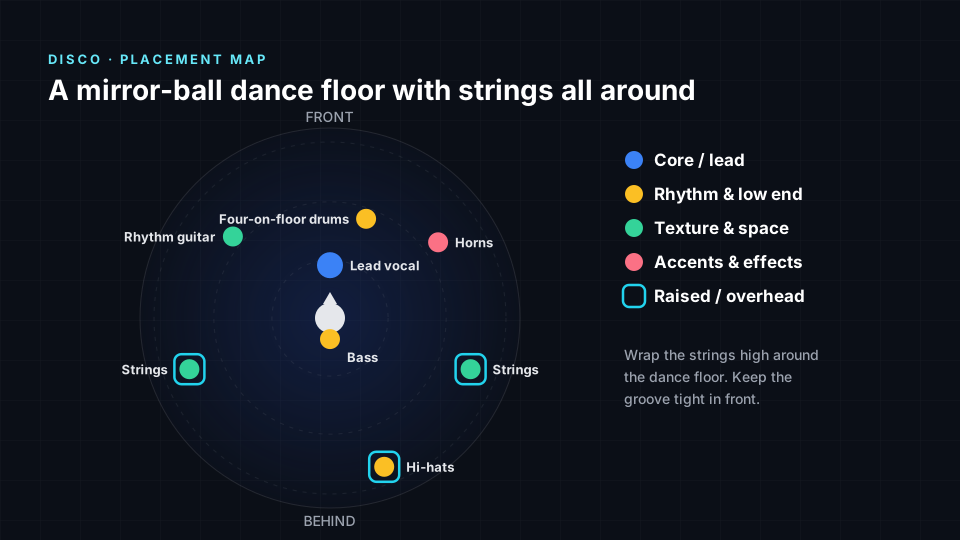
Immersive music for disco: what listeners hear
- A groove you can lean on. Kick, bass and hats stay locked and punchy.
- Strings all around. Sweeping string lines rise up on both sides.
- Horns that answer. Brass stabs jump in from the front right.
- A shimmering room. Hi-hats and reverb sparkle above like a mirror ball.
Where to place each element in a disco mix
| Element | Position | Height | Why it works |
|---|---|---|---|
| Lead vocal | Front centre | Ear level | The star of the record |
| Four-on-the-floor drums | Front | Ear level | Drives the dance floor |
| Bass | Centre | Ear level | Locks with the kick |
| Rhythm guitar | Front left | Ear level | The classic chicken-scratch groove |
| Horns | Front right | Ear level | Stabs answer the guitar |
| Strings | Left and right | Raised | Lush, sweeping scale |
| Hi-hats | Behind | Raised | Sparkle and air |
The psychoacoustics behind disco placement
Every position in the table above follows how the ear and brain locate sound. Here is the reason behind the main choices for disco.
- Four-on-the-floor drums and bass centred. Deep bass is the hardest sound for the ear to locate. Its wavelengths are several metres long, far larger than your head, so both ears receive almost the same level and only a tiny timing difference. The dance pulse stays rock solid, as it did on club systems.
- Rhythm guitar left, horns right. Sounds that overlap in pitch mask each other less when they arrive from different directions, so spreading them keeps every part clear without extra EQ. Choppy guitar and horn stabs live in the same range, so splitting them keeps both funky.
- Strings left and right, raised. Sound arriving from the sides, slightly different at each ear, creates the feeling of being inside the music. Acousticians call this envelopment. Disco strings were recorded big and lush, and side placement turns them into a wrap-around sweep.
- Hi-hats behind and raised. Height is heard mainly through treble: the folds of the outer ear colour frequencies above roughly 4 kHz differently for each elevation, so airy, bright parts are the ones that truly sound overhead. The open hat is pure treble, so it sits convincingly up and around you.
The immersion profile for disco
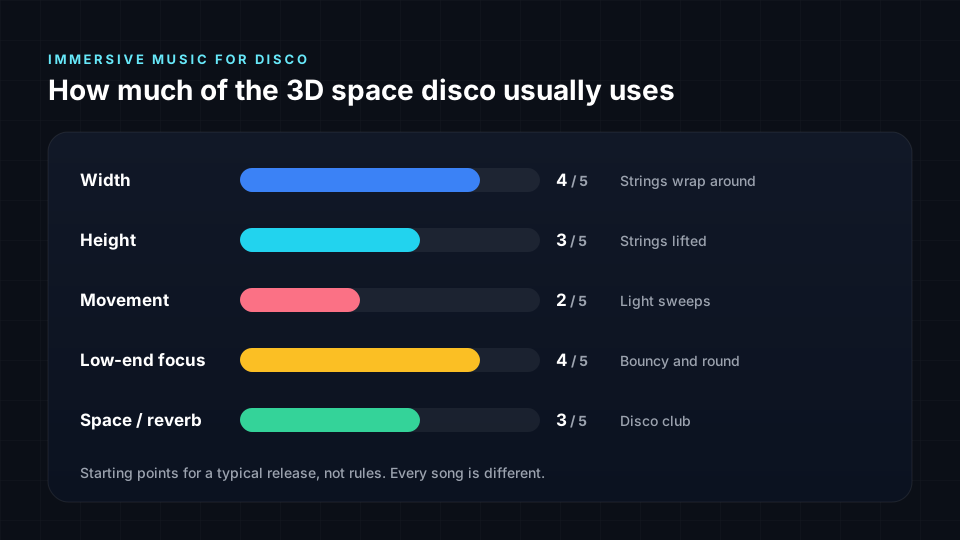
Disco scores high for width and low end. Movement stays low because the arrangement already provides motion: the music swings, so the sounds do not need to fly around.
Tips for an immersive disco mix
- Treat it like a live band. Fixed positions for each section sound natural and classic.
- Raise the strings. Height makes string sweeps feel cinematic.
- Keep the guitar and hats tight. Their timing is the groove, so do not wash them in reverb.
- Let the horns punch. Short stabs from one side add excitement.
- Save the widest moment for the break. Open the strings fully when the band drops out.
Disco styles: nu disco, Italo, French house and boogie
The core placement from this guide still applies to every style: drums, bass and lead vocal tight in front, strings raised to the sides and hats sparkling above and behind. Here is what changes from one style to the next.
Nu disco
Nu disco is the modern take on the sound, mixing disco basslines, strings and guitar with analogue synths, re-edited loops and often slower, laid-back tempos. Keep the groove and bass centred as in the main guide, but give synth arpeggios a slow glide across the sides and place synth pads raised behind alongside the strings. Rhythm guitar stays front left and dry. Movement can rise slightly above classic disco, but only on one part at a time.
Italo disco
Italo disco is the synth-driven European style of the early 1980s: drum machines, sequenced octave basslines, bright melodic synth leads and sometimes vocoder vocals. With fewer live players, think in synth layers instead of band sections. Keep the sequenced bass centred with the kick, put the lead synth front centre next to the vocal and spread chord synths raised to the left and right where the strings would sit. Keep the space bright and fairly dry.
French house
French house loops filtered disco samples over a heavy kick, with deep filter sweeps and pumping sidechain compression. The sample loop carries the strings, guitar and horns together, so keep it front and fairly narrow while the filter is closed. As the filter opens, let the loop widen to the sides and rise, which turns the classic sweep into real motion. The kick and bass stay centred and punchy throughout.
Boogie
Boogie is the slower, funkier sound that followed disco, with synth bass, electric piano, drum machines mixed with live drums and smooth vocals. Mix it tighter and smaller than classic disco. The synth bass stays centred, electric piano takes the rhythm guitar's place at front left, and strings, if present, sit lower and closer. Use short reverbs so the funk stays crisp.
The same approach works for funky house, disco house and post-disco. Funky house and disco house follow the French house idea, with looped disco samples that widen as the filter opens, while post-disco sits close to boogie, with tighter spaces and synths in place of strings.
Dolby Atmos and object-based mixing for disco
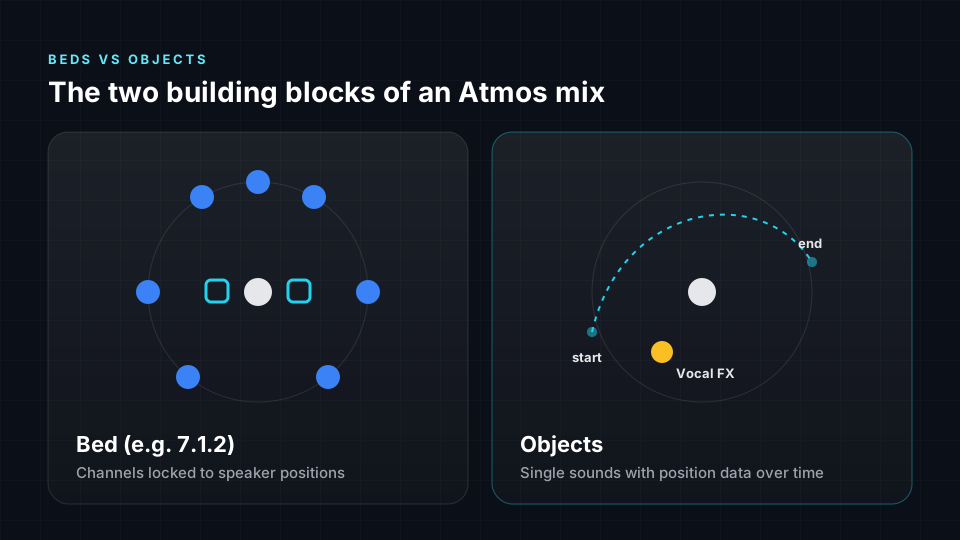
Dolby Atmos mixes disco as a channel bed plus objects placed anywhere in the room. Most listeners will hear the result on headphones through binaural rendering on services like Apple Music, Tidal and Amazon Music. Spatial9 helps plan placements for every format so your mix translates well. The channel bed anchors the heavy disco groove, while objects allow strings and horns to sit precisely in the 3D space. This hybrid approach gives you the power to create a club experience that works on any playback system.

How the Atmos plan differs from the placement map. The Atmos plan moves the bass and kick drum from the right and behind into the centre channel bed to keep the low end solid. The hi-hats move from behind to the front right and slightly raised, ensuring they do not lose focus on headphones. The strings start further forward and sweep back, using the room depth rather than sitting statically at the sides. The lead vocal is pulled slightly off the front wall for depth.
Beds and objects for each disco element
| Element | Atmos role | Where it plays in 7.1.4 | Binaural mode | Why |
|---|---|---|---|---|
| Lead vocal | Object | Ear level, front of the room, centre (X 0, Y 0.6, Z 0) | Near | Keeps the main vocal focused and intimate in the front stage. |
| Four-on-floor drum | Bed | Centre plus LFE (C + LFE) | Off | Anchors the groove in the centre and feeds the subwoofer. |
| Bass | Bed | Centre plus LFE (C + LFE) | Off | Locks with the kick drum to drive the dance floor. |
| Strings | Object, medium size, moving | Raised, middle of the room, far left (X -0.8, Y 0.2, Z 0.6). Moving: Sweeps overhead and back during the chorus, ending at overhead, middle of the room, left | Mid | Creates a lush cinematic sweep around the listener. |
| Strings | Object, medium size, moving | Raised, middle of the room, far right (X 0.8, Y 0.2, Z 0.6). Moving: Mirrors the left strings to sweep overhead during the chorus, ending at overhead, middle of the room, right | Mid | Balances the left strings for a wide enveloping section. |
| Rhythm guitar | Object, small size | Ear level, front of the room, left (X -0.6, Y 0.7, Z 0) | Mid | Sits clearly in the front stage to maintain the funky groove. |
| Horns | Object, small size | Ear level, front of the room, right (X 0.6, Y 0.7, Z 0) | Mid | Answers the guitar from the opposite side without masking it. |
| Hi-hats | Object | Raised, front of the room, right (X 0.4, Y 0.5, Z 0.5) | Mid | Adds sparkle above the groove without losing focus on headphones. |
Dolby Atmos settings for disco
- LFE. Objects have no LFE send, so place the kick and bass in the bed to use bass management on playback systems.
- Object size. Keep the lead vocal and rhythm guitar as point or small objects for focus, using medium size only for wide string sections.
- Height use. Keep dry rhythmic parts like hi-hats only slightly raised so they do not lose impact when folded down to stereo.
- Binaural render. Set the kick and bass to off for a solid centre, use near for the lead vocal, and mid for horns and guitars.
- Movement. Automate the string objects to sweep overhead during the chorus to add excitement without disrupting the core disco groove.
Disco across immersive formats
| Format | How it carries sound | What it means for disco |
|---|---|---|
| Dolby Atmos | Hybrid: a 7.1.2 channel bed plus up to 118 objects placed with X, Y and Z metadata | Dolby Atmos uses a hybrid of a channel bed for the disco groove and objects for horns and strings. |
| Sony 360 Reality Audio | Object-based, built on MPEG-H 3D Audio: every sound is an object on a sphere | Sony 360 Reality Audio has no channel bed, so every disco element becomes an object on a sphere. |
| MPEG-H 3D Audio | Channels, objects and Higher Order Ambisonics in one stream, with optional listener control | MPEG-H 3D Audio allows listeners to adjust the level of specific disco objects if the producer allows it. |
| Auro-3D | Channel-based: a height layer above 5.1 or 7.1, with an optional overhead channel | Auro-3D relies entirely on fixed channels for height, meaning disco strings cannot be placed as free objects. |
| Eclipsa Audio (IAMF) | Channel-based and scene-based (Ambisonics) audio elements; no objects | Eclipsa Audio uses IAMF which has no audio objects, so your Atmos mix renders to channels or Ambisonics. |
| Ambisonics | Scene-based: the whole sound field, decoded to any speaker layout or to headphones | Ambisonics stores the entire disco mix as a spherical sound field rather than individual objects or channels. |
| ADM BWF | Open exchange file (ITU-R BS.2076 metadata in a BW64 file) for channels, objects and scenes | ADM BWF is the open metadata file format you deliver to streaming services for your immersive disco master. |
Delivery checklist for a disco Dolby Atmos release
- Master file. ADM BWF at 48 kHz and 24-bit, with no more than 128 channels: a 10-channel 7.1.2 bed plus up to 118 objects.
- Loudness. Integrated loudness no higher than -18 LKFS and true peak no higher than -1 dBTP, measured to ITU-R BS.1770.
- Binaural metadata. Set Off, Near, Mid or Far for every bed and object. Masters with everything left on Off are rejected.
- Re-renders. Listen to the 5.1, stereo and binaural re-renders before delivery, because most people will hear one of them.
Check that your kick and bass remain punchy in the binaural render before delivering the final master.
How to make immersive disco from stereo
Spatial9 can create spatial audio from a stereo track in a few steps:
- Upload your stereo master or your stems.
- Spatial9's AI separates and places each part, from strings to horns.
- Preview it in binaural on headphones.
- Export Eclipsa Audio, ADM, binaural or Ambisonics.
- Publish a video. Create a YouTube-ready video with your immersive audio and publish it directly.
For related guides, read spatial audio for funk and spatial audio for house. Every guide is listed in spatial audio and immersive music by genre.
Frequently asked questions
Does this guide cover nu disco, Italo disco, French house and boogie?
Yes. All four keep the drums, bass and lead vocal tight in front. Nu disco adds slow-gliding synth arps and raised pads. Italo disco spreads chord synths where the strings would sit and keeps the space bright and dry. French house widens and lifts the sample loop as the filter opens. Boogie stays tighter and smaller, with electric piano at front left.
Can I make a disco mix in Dolby Atmos or Eclipsa Audio?
Can I make a disco mix in Dolby Atmos? Yes, Dolby Atmos is ideal for disco because it gives you a channel bed for the heavy rhythm section and objects for the lush strings and horns. You must deliver an ADM BWF master at 48 kHz and 24-bit. Remember that Eclipsa Audio is a separate delivery because it does not support objects. Always check your mix on Apple Music separately, as it applies its own spatial renderer that can sound different from the Dolby binaural render.
Should disco elements be beds or objects in Dolby Atmos?
Should disco elements be beds or objects in Dolby Atmos? The kick drum and bass should always go in the bed. This keeps the low end solid and ensures it feeds the LFE channel properly. Steady, enveloping parts like room reverb also work well in the bed. Everything else should be an object. The lead vocal, rhythm guitar, horns and strings all benefit from the precise placement and depth that objects provide, allowing you to build a clear and wide soundstage around the core groove.
Does a disco Dolby Atmos mix also work for Sony 360 Reality Audio and MPEG-H?
Does a disco Dolby Atmos mix also work for Sony 360 Reality Audio and MPEG-H? Not directly. Sony 360 Reality Audio is built on MPEG-H 3D Audio and uses a completely different object-based system with no channel bed. Because your Atmos mix relies on the bed for the kick and bass, you must create a separate mix for Sony 360 where every element is placed as an object on a sphere. The Atmos ADM file cannot simply be converted without adjusting these fundamental placement differences.
Is spatial audio good for disco?
Yes. Disco is arranged in sections, and spreading strings, horns and guitar around the listener makes it feel like a live orchestra on the dance floor.
Where should strings go in an immersive disco mix?
Wide and raised on both sides of the listener. That gives the classic string sweeps height and scale.
Can I remix an old disco record in spatial audio?
Yes. Spatial9 can separate a stereo master into its parts and place them in 3D, even when the original multitracks are lost.
Should disco sounds move around?
Mostly no. Fixed positions keep the band feel. A gentle swirl on a string sweep or filter effect is enough.
Does immersive disco work on normal headphones?
Yes. The mix is rendered binaurally, so the 3D effect works on any regular headphones.
Dolby and Dolby Atmos are trademarks of Dolby Laboratories. 360 Reality Audio, Auro-3D and other format names are trademarks of their respective owners. Spatial9 is not affiliated with or endorsed by Dolby Laboratories or these companies.
Sources
- Blauert, J. (1997). Spatial Hearing: The Psychophysics of Human Sound Localization, revised edition. MIT Press. Low-frequency, elevation, distance and motion cues.
- Mills, A. W. (1958). On the minimum audible angle. Journal of the Acoustical Society of America, 30(4), 237-246.
- Hebrank, J. and Wright, D. (1974). Spectral cues used in the localization of sound sources on the median plane. Journal of the Acoustical Society of America, 56(6), 1829-1834.
- Bronkhorst, A. W. (2000). The cocktail party phenomenon: a review of research on speech intelligibility in multiple-talker conditions. Acta Acustica united with Acustica, 86, 117-128.
- Litovsky, R. Y., Colburn, H. S., Yost, W. A. and Guzman, S. J. (1999). The precedence effect. Journal of the Acoustical Society of America, 106(4), 1633-1654.
- Barron, M. and Marshall, A. H. (1981). Spatial impression due to early lateral reflections in concert halls. Journal of Sound and Vibration, 77(2), 211-232.
- Neuhoff, J. G. (1998). Perceptual bias for rising tones. Nature, 395, 123-124.
- Bregman, A. S. (1990). Auditory Scene Analysis: The Perceptual Organization of Sound. MIT Press.
- Dolby Laboratories. Dolby Atmos for content creators. Dolby Professional. professional.dolby.com. 7.1.2 bed, audio objects with X, Y, Z metadata and renderer re-renders.
- Production Expert. Mixing Dolby Atmos on headphones: a professional guide. production-expert.com. Binaural render modes Off, Near, Mid and Far.
- Universal Music Group. Content Guide: Dolby Atmos servicing asset specifications. contentguide.universalmusic.com. ADM BWF, 48 kHz, 24-bit, 128 channels, binaural metadata and -18 LKFS.
- International Telecommunication Union. Recommendation ITU-R BS.2076: Audio Definition Model.
- International Telecommunication Union. Recommendation ITU-R BS.2088: Long-form file format for the international exchange of audio programme materials with metadata (BW64).
- International Telecommunication Union. Recommendation ITU-R BS.2051: Advanced sound system for programme production.
- International Telecommunication Union. Recommendation ITU-R BS.1770: Algorithms to measure audio programme loudness and true-peak audio level.
- European Broadcasting Union. ADM related standards. adm.ebu.io.
- ISO/IEC 23008-3. Information technology. High efficiency coding and media delivery in heterogeneous environments. Part 3: 3D audio (MPEG-H 3D Audio).
- Herre, J., Hilpert, J., Kuntz, A. and Plogsties, J. (2015). MPEG-H 3D Audio: the new standard for coding of immersive spatial audio. IEEE Journal of Selected Topics in Signal Processing, 9(5), 770-779.
- Sony Corporation. 360 Reality Audio licensing. sony.co.jp. Object-based spatial audio based on MPEG-H 3D Audio.
- Alliance for Open Media. Immersive Audio Model and Formats (IAMF). aomediacodec.github.io/iamf. Channel-based and scene-based audio elements.
- Zotter, F. and Frank, M. (2019). Ambisonics: A Practical 3D Audio Theory for Recording, Studio Production, Sound Reinforcement, and Virtual Reality. Springer.
Put your listeners under the mirror ball
Upload a track to Spatial9 and hear your strings and horns surround the dance floor in minutes. Then export it or publish it straight to YouTube.