Spatial Audio & Immersive Music for Experimental Music: Noise, Japanoise, Power Electronics & Avant-Garde
Spatial9 Team · · Updated · 14 min read
Part of the series Spatial audio and immersive music by genre.
Key takeaways
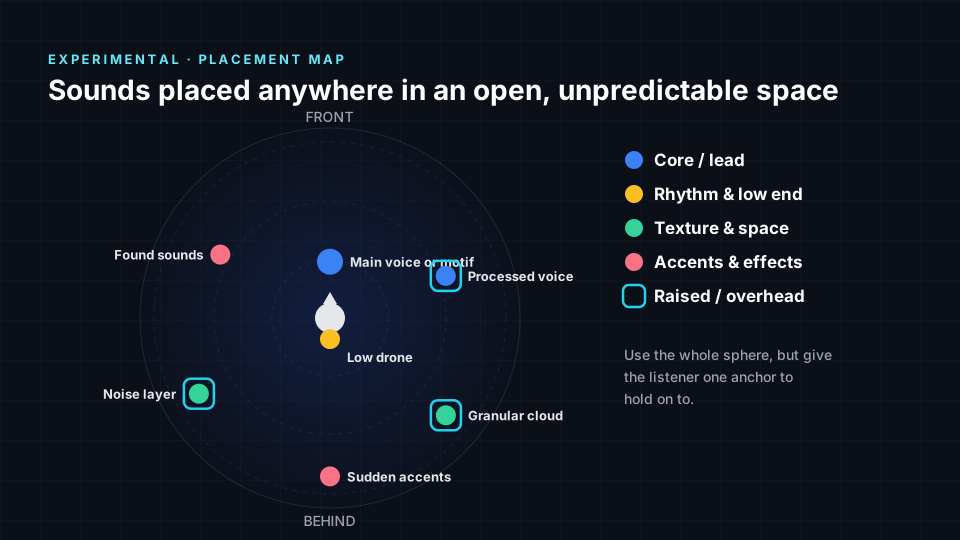
- Experimental music can use the whole sphere, but works best with one anchor such as a main voice or motif at front centre and a low drone centred.
- Found sounds can move across the front left, while noise layers and granular clouds sit raised behind the listener on either side.
- The guide advises treating movement as a musical line and leaving silence around events so each new sound is more striking.
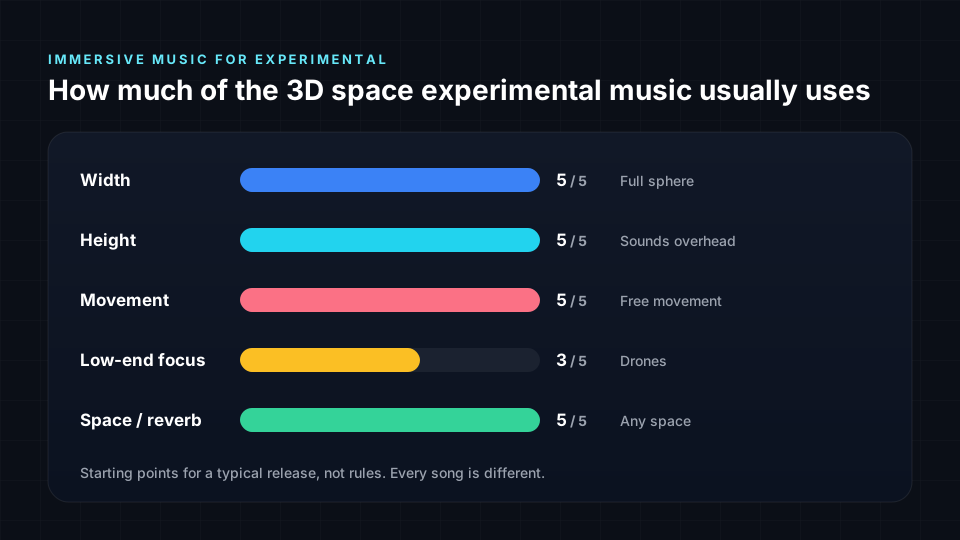
- Experimental music scores width 5, height 5, movement 5, low-end focus 3 and space 5 out of 5, the maximum on four dimensions.
Experimental music is a wide family of styles that break the usual rules of melody, rhythm and structure. Think of noise, drone, musique concrète built from recorded everyday sounds, granular synthesis, sound art, electroacoustic pieces and avant-garde improvisation. Many experimental composers worked with sound in space long before spatial audio reached streaming, using speaker domes and multi-speaker concerts. Spatial audio now lets anyone hear that kind of work on headphones. This guide covers how spatial audio for experimental music works, where to place each element and how to make an immersive experimental mix. For the basics, see what spatial audio is.
Why experimental music is perfect for spatial audio
In most genres, space supports the song. In experimental music, space can be the song. The direction, distance and movement of a sound can be as important as its pitch or rhythm. Stereo only offers a line between two speakers. Spatial audio offers a full sphere, including above and behind the listener, which opens up completely new ideas.
Total freedom can also be confusing. If everything moves all the time, the listener loses their bearings. A single anchor, such as a drone or a repeating motif, gives them something to hold on to while the rest of the piece explores the space.
The rule: use the whole sphere, but give the listener one anchor to hold on to.
Immersive music for experimental music: what listeners hear
- Sound as a place. The piece feels like a space you are standing inside.
- Surprise from every direction. Sounds can appear above, behind or right beside you.
- Real movement. Sounds travel around the listener as part of the composition.
- A thread to follow. The anchor keeps the experience focused.
Where to place each element in an experimental mix
| Element | Position | Height | Why it works |
|---|---|---|---|
| Main voice or motif | Front centre | Ear level | Gives the listener a clear anchor |
| Low drone | Centre | Ear level | Grounds the piece without a clear direction |
| Found sounds | Front left, moving | Ear level | Real-world sounds feel alive when they travel |
| Processed voice | Front right | Raised | Floating voices feel strange and dreamlike |
| Noise layer | Behind left | Raised | Texture above creates a sense of scale |
| Granular cloud | Behind right | Raised | Tiny grains of sound surround the listener |
| Sudden accents | Behind, moving | Ear level to raised | Unexpected events keep attention sharp |
The psychoacoustics behind experimental placement
- Front and back spectral cues. Our ears shape sound differently from behind and above, which makes height and rear placement clearly audible (Hebrank and Wright, 1974).
- Looming sounds grab attention. Sounds that rise or approach feel more urgent, a powerful tool for tension (Neuhoff, 1998).
- Grouping by location. Sounds from the same place tend to be heard as one stream, so placement can join or separate ideas (Bregman, 1990).
- The precedence effect. The first-arriving sound sets where we hear it, so short delays between positions can create surprising spatial illusions (Litovsky et al., 1999).
The immersion profile for experimental music
Tips for an immersive experimental mix
- Choose an anchor first. Decide what stays still before deciding what moves.
- Treat movement as a musical line. Plan where each sound travels, just like a melody.
- Use height on purpose. Sounds above the listener feel unusual, so save them for key moments.
- Leave silence around events. Empty space makes each new sound more striking.
- Check on headphones and speakers. Experimental pieces often rely on detail, so test on both.
Experimental music styles: noise, Japanoise, power electronics and avant-garde
The core placement from this guide still applies to every style: a clear anchor at front centre, a centred low drone and noise, grains and accents spread around and above. Here is what changes from one style to the next.
Noise
Noise music is built from dense, harsh textures: feedback, distortion, static and layered walls of sound, often with no beat or melody at all. In a spatial mix the noise layer becomes the main event, so spread it wide around the listener and lift it high instead of keeping it behind left. Give the wall a few slowly shifting zones of density rather than constant motion, and keep a low drone centred so the piece still has a floor.
Japanoise
Japanoise is the extreme, chaotic side of noise associated with the Japanese scene, known for overwhelming harshness, sudden cuts and violent shifts between textures. Make the moving sudden accents your key tool: jump abruptly between positions, front to rear and side to side, matching the hard edits. Silence and sharp cutoffs matter as much as the noise, so leave the space empty for a moment, then hit the listener from an unexpected direction.
Power electronics
Power electronics combines harsh noise with shouted, heavily distorted vocals, squealing synths and pulsing, oppressive drones. Treat the processed voice as the anchor: bring it to front centre at ear level, close and confrontational, rather than floating raised on the right. Pulsing drones stay centred and heavy, while feedback and synth squeals sit raised behind and at the sides. Keep movement more restrained than in pure noise so the pressure feels relentless and focused.
Avant-garde
Avant-garde music covers unconventional composition of many kinds: extended instrument techniques, tape and electroacoustic pieces, unusual structures and long silences. Here the space itself can be part of the score. Place found sounds and processed voices with intention, let granular clouds slowly surround the listener and use height for gestures that should feel distant or strange. Quieter, sparser pieces benefit from a large, natural room, so small details travel clearly through it.
Dolby Atmos and object-based mixing for experimental music
Dolby Atmos mixes experimental music as a channel bed plus objects placed anywhere in the room. The bed handles wide textures and low frequencies, while objects allow precise positioning for leads and moving sounds. Most listeners will hear the result on headphones through binaural rendering on Apple Music, Tidal or Amazon Music. Spatial9 helps plan placements for every format so your creative intent translates perfectly. A strong plan ensures the anchor remains clear while textures explore the space.

How the Atmos plan differs from the placement map. This Dolby Atmos plan differs from the Ambisonics map to suit object-based mixing. The low drone was behind in the map, but Atmos requires low end in the bed for bass management, so it moves to the front and LFE. The noise layer was to the side and raised, but a full bed better envelops the listener. The granular cloud and sudden accents stay behind, using the rear speakers to create startling moments without cluttering the main stage.
Beds and objects for each experimental music element
| Element | Atmos role | Where it plays in 7.1.4 | Binaural mode | Why |
|---|---|---|---|---|
| Main voice or moti | Object | Ear level, front of the room, centre (X 0, Y 0.7, Z 0) | Near | Keeps the main anchor focused and present in the front stage. |
| Low drone | Bed | Centre plus LFE (C + LFE) | Off | Low frequencies need solid channel routing and bass management for impact. |
| Found sounds | Object, small size, moving | Ear level, front of the room, far left (X -0.8, Y 0.5, Z 0). Moving: Drifts along the left wall to create a sense of living space, ending at ear level, middle of the room, far left | Mid | Movement adds life to real-world textures in experimental music. |
| Processed voice | Object, medium size | Raised, front of the room, far right (X 0.8, Y 0.5, Z 0.6) | Mid | Floating above the right side adds a dreamlike spatial contrast. |
| Noise layer | Bed | Whole 7.1.2 bed | Far | A full bed wraps the harsh textures completely around the listener. |
| Granular cloud | Object, wide size, moving | Overhead, rear of the room, right (X 0.7, Y -0.7, Z 0.8). Moving: Sweeps slowly across the rear ceiling to disorient the listener, ending at overhead, rear of the room, left | Far | Overhead movement suits scattered grains and builds spatial tension. |
| Sudden accents | Object | Raised, back wall, centre (X 0, Y -0.9, Z 0.5) | Mid | Rear placement makes unexpected events feel startling and immediate. |
Dolby Atmos settings for experimental music
- LFE. Route the low drone to the LFE channel within the bed to ensure proper bass management on consumer systems.
- Object size. Increase the size of the processed voice to spread it across multiple speakers, making it feel less like a point source.
- Height use. Keep the granular cloud and processed voice raised to create a sense of scale, but leave the main voice at ear level.
- Binaural render modes. Set the low drone to off for a solid centre, the main voice to near, and the noise layer to far for maximum width.
- Movement. Automate the found sounds and granular cloud slowly to prevent motion sickness while maintaining an unpredictable experimental music atmosphere.
Experimental music across immersive formats
| Format | How it carries sound | What it means for experimental music |
|---|---|---|
| Dolby Atmos | Hybrid: a 7.1.2 channel bed plus up to 118 objects placed with X, Y and Z metadata | Dolby Atmos supports a channel bed and up to 118 objects, making it ideal for placing experimental music textures around the listener. |
| Sony 360 Reality Audio | Object-based, built on MPEG-H 3D Audio: every sound is an object on a sphere | Sony 360 Reality Audio uses only objects on a sphere, so experimental music beds must be converted to static objects. |
| MPEG-H 3D Audio | Channels, objects and Higher Order Ambisonics in one stream, with optional listener control | MPEG-H 3D Audio allows listeners to adjust the level of specific experimental music objects if the producer enables it. |
| Auro-3D | Channel-based: a height layer above 5.1 or 7.1, with an optional overhead channel | Auro-3D relies on fixed height channels rather than objects, so experimental music height effects are routed to the upper speaker layers. |
| Eclipsa Audio (IAMF) | Channel-based and scene-based (Ambisonics) audio elements; no objects | Eclipsa Audio uses IAMF which lacks audio objects, meaning your Atmos mix must be rendered to channels or Ambisonics first. |
| Ambisonics | Scene-based: the whole sound field, decoded to any speaker layout or to headphones | Ambisonics captures the entire experimental music sound field as spherical harmonics, allowing decoding to any speaker layout or headphones. |
| ADM BWF | Open exchange file (ITU-R BS.2076 metadata in a BW64 file) for channels, objects and scenes | ADM BWF is the standard delivery file that stores all channel and object metadata for your experimental music mix. |
Delivery checklist for a experimental music Dolby Atmos release
- Master file. ADM BWF at 48 kHz and 24-bit, with no more than 128 channels: a 10-channel 7.1.2 bed plus up to 118 objects.
- Loudness. Integrated loudness no higher than -18 LKFS and true peak no higher than -1 dBTP, measured to ITU-R BS.1770.
- Binaural metadata. Set Off, Near, Mid or Far for every bed and object. Masters with everything left on Off are rejected.
- Re-renders. Listen to the 5.1, stereo and binaural re-renders before delivery, because most people will hear one of them.
Check that your experimental music mix measures no higher than -18 LKFS integrated loudness before exporting the final ADM BWF.
How to make immersive experimental music from stereo
Spatial9 can create spatial audio from a stereo track in a few steps:
- Upload your stereo master or your stems.
- Spatial9's AI separates and places each part, from drones and voices to textures and found sounds.
- Preview it in binaural on headphones.
- Export Eclipsa Audio, ADM, binaural or Ambisonics.
- Publish a video. Create a YouTube-ready video with your immersive audio and publish it directly.
For related guides, read spatial audio for ambient music, spatial audio for minimal techno and spatial audio for film and game scores. Every guide is listed in spatial audio and immersive music by genre.
Frequently asked questions
Does this guide cover noise, Japanoise, power electronics and avant-garde music?
Yes. Every style keeps a clear front anchor and a centred low drone. Noise spreads its harsh wall wide and high with slowly shifting density. Japanoise uses abrupt jumps between positions and sharp silences. Power electronics brings the distorted voice close to front centre with feedback raised behind. Avant-garde treats space as part of the composition, with granular clouds surrounding the listener and height for distant gestures.
Can I make an experimental mix in Dolby Atmos or Eclipsa Audio?
Can I make an experimental music mix in Dolby Atmos? Yes, Dolby Atmos is the standard format for immersive music delivery to streaming services. You can use a channel bed for your drones and noise layers, and objects for precise, moving sounds. Note that Eclipsa Audio is a separate delivery since it uses IAMF and has no objects. Also, Apple Music applies its own spatial renderer, so you must check how your mix sounds on their platform separately from the Dolby binaural render.
Should experimental music elements be beds or objects in Dolby Atmos?
Should experimental music elements be beds or objects in Dolby Atmos? It depends on their role. Wide, enveloping sounds like a noise layer or a low drone belong in the bed. The bed also handles the LFE channel for sub frequencies. Objects are better for precise elements like a main voice, sudden accents, or a granular cloud. Objects allow you to use X, Y, Z metadata to move sounds around the room, which is perfect for the unpredictable nature of experimental music.
Does a experimental music Dolby Atmos mix also work for Sony 360 Reality Audio and MPEG-H?
Does an experimental music Dolby Atmos mix also work for Sony 360 Reality Audio and MPEG-H? Not directly. Sony 360 Reality Audio is built on MPEG-H 3D Audio and uses a purely object-based sphere with no channel bed. If you have a low drone or noise layer in an Atmos bed, you must convert those channels into static objects to translate them to Sony 360. You will need to create a separate mix and export it using the specific tools for those formats.
Is Ambisonics a good format for experimental music?
Often, yes. Ambisonics captures a full sphere of sound and is popular for sound art and installations. Spatial9 can export Ambisonics alongside Eclipsa Audio, ADM and binaural.
Should everything move in an experimental mix?
No. Constant movement becomes tiring and hard to follow. Keep at least one element still so the movement of the others means something.
How do I use height in experimental music?
Place textures and processed sounds above the listener for moments of scale or strangeness. Height is unusual in everyday listening, so it is very noticeable.
Can I convert a released experimental piece to spatial audio?
Yes. Spatial9 uses AI to separate a stereo master into its parts and export an immersive mix as Eclipsa Audio, ADM, binaural or Ambisonics.
Does immersive experimental music work on normal headphones?
Yes. The mix is rendered binaurally, so sounds can appear around, above and behind you on any regular headphones.
Dolby and Dolby Atmos are trademarks of Dolby Laboratories. 360 Reality Audio, Auro-3D and other format names are trademarks of their respective owners. Spatial9 is not affiliated with or endorsed by Dolby Laboratories or these companies.
Sources
- Bregman, A. S. (1990). Auditory Scene Analysis: The Perceptual Organization of Sound. MIT Press.
- Hebrank, J. and Wright, D. (1974). Spectral cues used in the localization of sound sources on the median plane. Journal of the Acoustical Society of America, 56(6), 1829-1834.
- Litovsky, R. Y., Colburn, H. S., Yost, W. A. and Guzman, S. J. (1999). The precedence effect. Journal of the Acoustical Society of America, 106(4), 1633-1654.
- Neuhoff, J. G. (1998). Perceptual bias for rising tones. Nature, 395, 123-124.
- Blauert, J. (1997). Spatial Hearing: The Psychophysics of Human Sound Localization, revised edition. MIT Press.
- Dolby Laboratories. Dolby Atmos for content creators. Dolby Professional. professional.dolby.com. 7.1.2 bed, audio objects with X, Y, Z metadata and renderer re-renders.
- Production Expert. Mixing Dolby Atmos on headphones: a professional guide. production-expert.com. Binaural render modes Off, Near, Mid and Far.
- Universal Music Group. Content Guide: Dolby Atmos servicing asset specifications. contentguide.universalmusic.com. ADM BWF, 48 kHz, 24-bit, 128 channels, binaural metadata and -18 LKFS.
- International Telecommunication Union. Recommendation ITU-R BS.2076: Audio Definition Model.
- International Telecommunication Union. Recommendation ITU-R BS.2088: Long-form file format for the international exchange of audio programme materials with metadata (BW64).
- International Telecommunication Union. Recommendation ITU-R BS.2051: Advanced sound system for programme production.
- International Telecommunication Union. Recommendation ITU-R BS.1770: Algorithms to measure audio programme loudness and true-peak audio level.
- European Broadcasting Union. ADM related standards. adm.ebu.io.
- ISO/IEC 23008-3. Information technology. High efficiency coding and media delivery in heterogeneous environments. Part 3: 3D audio (MPEG-H 3D Audio).
- Herre, J., Hilpert, J., Kuntz, A. and Plogsties, J. (2015). MPEG-H 3D Audio: the new standard for coding of immersive spatial audio. IEEE Journal of Selected Topics in Signal Processing, 9(5), 770-779.
- Sony Corporation. 360 Reality Audio licensing. sony.co.jp. Object-based spatial audio based on MPEG-H 3D Audio.
- Alliance for Open Media. Immersive Audio Model and Formats (IAMF). aomediacodec.github.io/iamf. Channel-based and scene-based audio elements.
- Zotter, F. and Frank, M. (2019). Ambisonics: A Practical 3D Audio Theory for Recording, Studio Production, Sound Reinforcement, and Virtual Reality. Springer.
Turn your sound into a space
Upload an experimental piece to Spatial9 and hear it unfold around you in minutes. Then export it or publish it straight to YouTube.