Spatial Audio & Immersive Music for Progressive Trance: Complete Guide
Spatial9 Team · · Updated · 12 min read
Part of the series Spatial audio and immersive music by genre.
Key takeaways
- Immersive progressive trance keeps the kick, rolling bass and lead in front and centre, with gated pads raised on the left.
- Pluck sequences move gently along the right side, while atmosphere and reverb tails fill the space high behind the listener.
- The progressive trance rule is to save full height for the big breakdown, keeping pads lower until then.
- Progressive trance scores width 5, height 4, movement 4, low-end focus 4 and space 5 out of 5 in its immersion profile.
Progressive trance takes the euphoria of trance and stretches it over a longer, deeper journey. Rolling basslines, hypnotic plucks and gated pads build tension for minutes before the big breakdown. Spatial audio lets that journey travel through space as well as time. This guide covers how spatial audio for progressive trance works, where to place each element and how to make an immersive progressive trance mix. For the basics, see what spatial audio is.
Why progressive trance is a natural fit for 3D
The genre is built on long arcs. Each section adds texture, and the breakdown releases it all at once. A 3D mix can hold the space back for most of the track, then open it fully at the emotional peak.
The rule: save full height for the big breakdown. That is the moment the listener should feel the sky open.
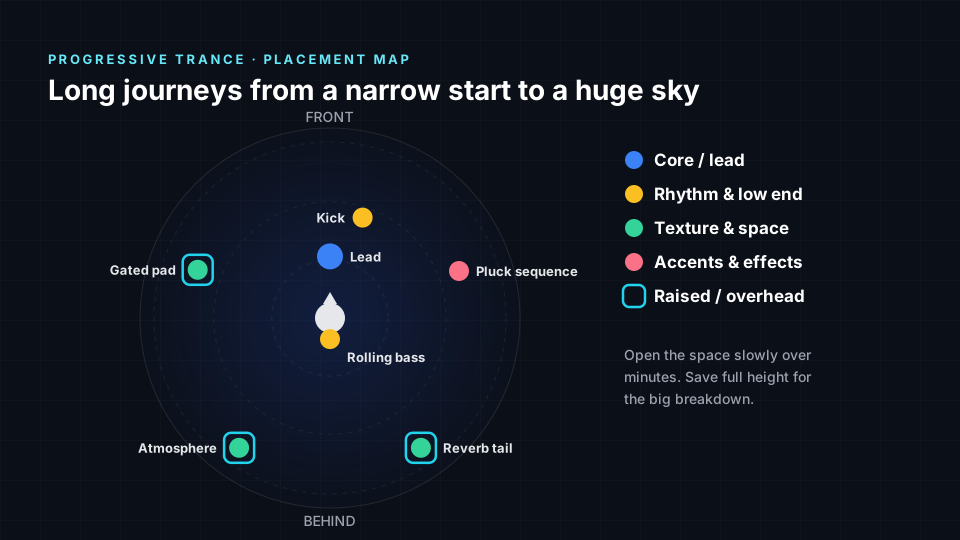
Immersive music for progressive trance: what listeners hear
- A rolling engine. Kick and bass drive forward without pause.
- Pulsing pads. Gated pads rise and pulse to the left.
- Plucks in motion. Sequences travel along the right side.
- A sky that opens. Atmosphere and reverb tails expand overhead in the breakdown.
Where to place each element in a progressive trance mix
| Element | Position | Height | Why it works |
|---|---|---|---|
| Lead | Front centre | Ear level | The melody of the journey |
| Kick | Front | Ear level | Constant drive |
| Rolling bass | Centre | Ear level | The engine of the track |
| Gated pad | Left | Raised | Rhythmic texture above |
| Pluck sequence | Right, moving | Ear level | Hypnotic motion |
| Atmosphere | Behind left | Raised | Depth and scale |
| Reverb tail | Behind right | Raised | The open sky |
The psychoacoustics behind progressive trance placement
Every position in the table above follows how the ear and brain locate sound. Here is the reason behind the main choices for progressive trance.
- Kick and rolling bass centred. Deep bass is the hardest sound for the ear to locate. Its wavelengths are several metres long, far larger than your head, so both ears receive almost the same level and only a tiny timing difference. The rolling groove must stay stable for the track to drive.
- Gated pad left, pluck sequence right. Sounds that overlap in pitch mask each other less when they arrive from different directions, so spreading them keeps every part clear without extra EQ. Two rhythmic synth parts stay distinct when they are split.
- Pluck sequence moving. The ear needs a larger angle to notice movement than to notice position, so slow, wide moves are followed easily while fast ones blur into a wash. Slow movement makes a repeating sequence feel like it is travelling.
- Atmosphere and reverb tail behind. Concert hall research shows that reflections from the sides, not from the front, create the sense of width and of being surrounded (Barron and Marshall, 1981). Space behind and around the listener gives the breakdown its emotional size.
The immersion profile for progressive trance
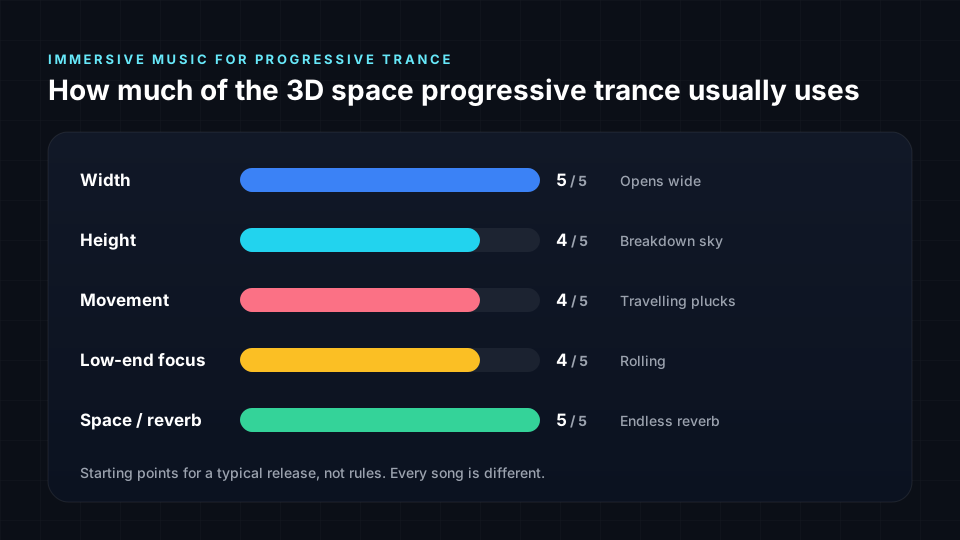
Progressive trance scores top marks for width and space. Compared with classic trance, it uses height more patiently and relies more on a rolling, hypnotic groove.
Tips for an immersive progressive trance mix
- Hold back the height. Keep pads lower until the main breakdown.
- Move the plucks gently. A slow sweep along one side keeps the groove hypnotic.
- Keep the bass rolling and centred. It is the engine of the whole track.
- Make the breakdown the widest moment. Release all the space at once.
- Return to the front on the drop. Pull energy back to the centre when the kick comes in.
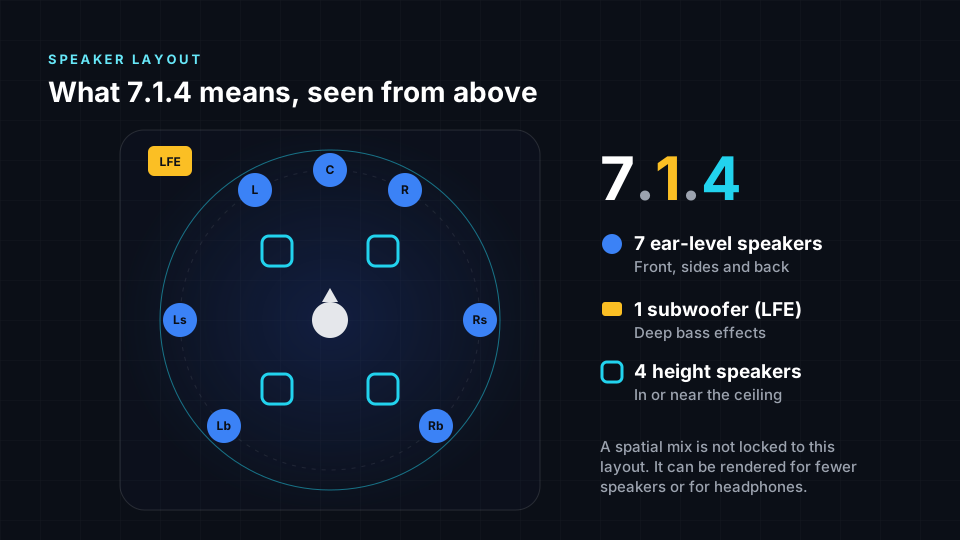
Dolby Atmos and object-based mixing for progressive trance
Dolby Atmos mixes progressive trance as a channel bed plus objects placed anywhere in the room. Most listeners will hear the result on headphones through binaural rendering on Apple Music, Tidal, or Amazon Music. Spatial9 helps plan placements for every format to ensure the track translates well. A strong spatial mix uses the bed for the rolling groove and atmosphere, while objects handle the lead and moving sequences.

How the Atmos plan differs from the placement map. The Atmos plan differs from the Ambisonics map mainly in the low end. The map placed the kick front right and the rolling bass behind right. In Atmos, low frequencies stay in the front centre bed with the LFE to ensure phase coherence and solid bass management. The map placed the atmosphere and reverb tail behind the listener, but in Atmos they use the full bed and overhead channels to create a deeper, enveloping space.
Beds and objects for each progressive trance element
| Element | Atmos role | Where it plays in 7.1.4 | Binaural mode | Why |
|---|---|---|---|---|
| Lead | Object, small size | Ear level, front of the room, centre (X 0, Y 0.7, Z 0) | Near | Main melody stays anchored in front to lead the journey. |
| Kick | Bed | Centre plus LFE (C + LFE) | Off | Low end foundation stays solid and centred in the bed. |
| Rolling bass | Bed | Centre plus LFE (C + LFE) | Off | Bass engine needs phase coherence and bass management. |
| Gated pad | Object, medium size | Raised, middle of the room, far left (X -0.8, Y 0.2, Z 0.6) | Mid | Raised on the left to add rhythmic texture above the groove. |
| Pluck sequence | Object, small size, moving | Ear level, front of the room, far right (X 0.8, Y 0.5, Z 0). Moving: Travels slowly along the right wall to create hypnotic motion, ending at ear level, middle of the room, far right | Mid | Movement keeps the sequence engaging without cluttering the front. |
| Atmosphere | Bed | Whole 7.1.2 bed | Far | Envelops the listener from all sides during the breakdown. |
| Reverb tail | Bed | Overhead bed pair (Ltm/Rtm) | Far | Fills the overhead space to create an open sky feeling. |
Dolby Atmos settings for progressive trance
- LFE. Route the kick and rolling bass to the LFE channel within the bed to ensure a powerful, club-ready low end.
- Object size. Keep the lead and pluck sequence small for focus, but increase the size of the gated pad to spread it across the left wall.
- Height use. Reserve the overhead channels for the atmosphere and reverb tails during the main breakdown to create maximum impact.
- Binaural render modes. Set the low end to off for solidity, the lead to near for intimacy, and the atmosphere to far for a huge sense of space.
- Automation. Move the pluck sequence slowly along the right side to maintain a hypnotic feel without distracting from the main groove.
Progressive trance across immersive formats
| Format | How it carries sound | What it means for progressive trance |
|---|---|---|
| Dolby Atmos | Hybrid: a 7.1.2 channel bed plus up to 118 objects placed with X, Y and Z metadata | Dolby Atmos combines a channel bed for the groove with objects for leads and moving plucks in progressive trance. |
| Sony 360 Reality Audio | Object-based, built on MPEG-H 3D Audio: every sound is an object on a sphere | Sony 360 Reality Audio uses only objects placed on a sphere, so the progressive trance bed must be converted to static objects. |
| MPEG-H 3D Audio | Channels, objects and Higher Order Ambisonics in one stream, with optional listener control | MPEG-H 3D Audio supports channels and objects, allowing listeners to adjust the level of the progressive trance lead if permitted. |
| Auro-3D | Channel-based: a height layer above 5.1 or 7.1, with an optional overhead channel | Auro-3D relies on fixed height channels rather than objects to create the huge spatial breakdowns typical of progressive trance. |
| Eclipsa Audio (IAMF) | Channel-based and scene-based (Ambisonics) audio elements; no objects | Eclipsa Audio uses IAMF which lacks objects, meaning the Atmos mix must be rendered to channels or Ambisonics for delivery. |
| Ambisonics | Scene-based: the whole sound field, decoded to any speaker layout or to headphones | Ambisonics captures the entire progressive trance sound field as a scene that can be decoded to any speaker layout or headphones. |
| ADM BWF | Open exchange file (ITU-R BS.2076 metadata in a BW64 file) for channels, objects and scenes | The ADM BWF file is the open metadata master format required by streaming services for your immersive progressive trance mix. |
Delivery checklist for a progressive trance Dolby Atmos release
- Master file. ADM BWF at 48 kHz and 24-bit, with no more than 128 channels: a 10-channel 7.1.2 bed plus up to 118 objects.
- Loudness. Integrated loudness no higher than -18 LKFS and true peak no higher than -1 dBTP, measured to ITU-R BS.1770.
- Binaural metadata. Set Off, Near, Mid or Far for every bed and object. Masters with everything left on Off are rejected.
- Re-renders. Listen to the 5.1, stereo and binaural re-renders before delivery, because most people will hear one of them.
Check the binaural render on headphones to ensure the rolling bass remains solid and the moving plucks do not disappear.
How to make immersive progressive trance from stereo
Spatial9 can create spatial audio from a stereo track in a few steps:
- Upload your stereo master or your stems.
- Spatial9's AI separates and places each part, lifting atmosphere into the space above.
- Preview it in binaural on headphones.
- Export Eclipsa Audio, ADM, binaural or Ambisonics.
- Publish a video. Create a YouTube-ready video with your immersive audio and publish it directly.
For related guides, read spatial audio for trance and spatial audio for psytrance. Every guide is listed in spatial audio and immersive music by genre.
Frequently asked questions
Can I make a progressive trance mix in Dolby Atmos or Eclipsa Audio?
Can I make a progressive trance mix in Dolby Atmos? Yes. You can build a hybrid mix using a channel bed for the rolling bass and atmosphere, and objects for the lead and moving plucks. Dolby Atmos and Eclipsa Audio require separate deliveries because Eclipsa uses IAMF, which has no audio objects. Always check your Atmos mix on Apple Music separately, as Apple applies its own spatial renderer that can change how the binaural version sounds on headphones compared to the Dolby renderer.
Should progressive trance elements be beds or objects in Dolby Atmos?
Should progressive trance elements be beds or objects in Dolby Atmos? It depends on their role. The kick, rolling bass, atmosphere, and reverb tails work best as beds to provide a solid foundation and wide envelopment. The main lead, gated pads, and pluck sequences should be objects. This allows you to place the lead precisely in front, raise the pad on the left, and automate the plucks to move slowly along the right wall for a hypnotic effect.
Does a progressive trance Dolby Atmos mix also work for Sony 360 Reality Audio and MPEG-H?
Does a progressive trance Dolby Atmos mix also work for Sony 360 Reality Audio and MPEG-H? Not directly. Sony 360 Reality Audio is built on MPEG-H 3D Audio but uses a sphere of objects with no channel bed. You must translate your Atmos bed elements, like the kick and rolling bass, into static objects to create a Sony 360 mix. MPEG-H supports both channels and objects, making it closer to the Atmos structure, and is widely used in broadcasting.
Is spatial audio good for progressive trance?
Yes. Its long builds and huge breakdowns are ideal for a space that slowly opens around the listener.
How is progressive trance different from trance in 3D?
Progressive trance builds more slowly and holds height back for longer. Classic trance often lifts the supersaws overhead much earlier.
Should the pluck sequence move?
It can. A slow movement along one side adds hypnotic motion without distracting from the lead.
Can I convert a finished progressive trance track to spatial audio?
Yes. Spatial9 uses AI to generate an immersive mix from a stereo master and exports it as Eclipsa Audio, ADM, binaural or Ambisonics.
Does immersive progressive trance work on normal headphones?
Yes. The mix is rendered binaurally, so the height and width work on any regular headphones.
Dolby and Dolby Atmos are trademarks of Dolby Laboratories. 360 Reality Audio, Auro-3D and other format names are trademarks of their respective owners. Spatial9 is not affiliated with or endorsed by Dolby Laboratories or these companies.
Sources
- Blauert, J. (1997). Spatial Hearing: The Psychophysics of Human Sound Localization, revised edition. MIT Press. Low-frequency, elevation, distance and motion cues.
- Mills, A. W. (1958). On the minimum audible angle. Journal of the Acoustical Society of America, 30(4), 237-246.
- Hebrank, J. and Wright, D. (1974). Spectral cues used in the localization of sound sources on the median plane. Journal of the Acoustical Society of America, 56(6), 1829-1834.
- Bronkhorst, A. W. (2000). The cocktail party phenomenon: a review of research on speech intelligibility in multiple-talker conditions. Acta Acustica united with Acustica, 86, 117-128.
- Litovsky, R. Y., Colburn, H. S., Yost, W. A. and Guzman, S. J. (1999). The precedence effect. Journal of the Acoustical Society of America, 106(4), 1633-1654.
- Barron, M. and Marshall, A. H. (1981). Spatial impression due to early lateral reflections in concert halls. Journal of Sound and Vibration, 77(2), 211-232.
- Neuhoff, J. G. (1998). Perceptual bias for rising tones. Nature, 395, 123-124.
- Bregman, A. S. (1990). Auditory Scene Analysis: The Perceptual Organization of Sound. MIT Press.
- Dolby Laboratories. Dolby Atmos for content creators. Dolby Professional. professional.dolby.com. 7.1.2 bed, audio objects with X, Y, Z metadata and renderer re-renders.
- Production Expert. Mixing Dolby Atmos on headphones: a professional guide. production-expert.com. Binaural render modes Off, Near, Mid and Far.
- Universal Music Group. Content Guide: Dolby Atmos servicing asset specifications. contentguide.universalmusic.com. ADM BWF, 48 kHz, 24-bit, 128 channels, binaural metadata and -18 LKFS.
- International Telecommunication Union. Recommendation ITU-R BS.2076: Audio Definition Model.
- International Telecommunication Union. Recommendation ITU-R BS.2088: Long-form file format for the international exchange of audio programme materials with metadata (BW64).
- International Telecommunication Union. Recommendation ITU-R BS.2051: Advanced sound system for programme production.
- International Telecommunication Union. Recommendation ITU-R BS.1770: Algorithms to measure audio programme loudness and true-peak audio level.
- European Broadcasting Union. ADM related standards. adm.ebu.io.
- ISO/IEC 23008-3. Information technology. High efficiency coding and media delivery in heterogeneous environments. Part 3: 3D audio (MPEG-H 3D Audio).
- Herre, J., Hilpert, J., Kuntz, A. and Plogsties, J. (2015). MPEG-H 3D Audio: the new standard for coding of immersive spatial audio. IEEE Journal of Selected Topics in Signal Processing, 9(5), 770-779.
- Sony Corporation. 360 Reality Audio licensing. sony.co.jp. Object-based spatial audio based on MPEG-H 3D Audio.
- Alliance for Open Media. Immersive Audio Model and Formats (IAMF). aomediacodec.github.io/iamf. Channel-based and scene-based audio elements.
- Zotter, F. and Frank, M. (2019). Ambisonics: A Practical 3D Audio Theory for Recording, Studio Production, Sound Reinforcement, and Virtual Reality. Springer.
Take your listeners on the full journey
Upload a track to Spatial9 and hear your progressive trance open into a huge sky in minutes. Then export it or publish it straight to YouTube.