Spatial Audio & Immersive Music for Tejano: Conjunto, Norteño & Tex-Mex
Spatial9 Team · · Updated · 17 min read
Part of the series Spatial audio and immersive music by genre.
Key takeaways
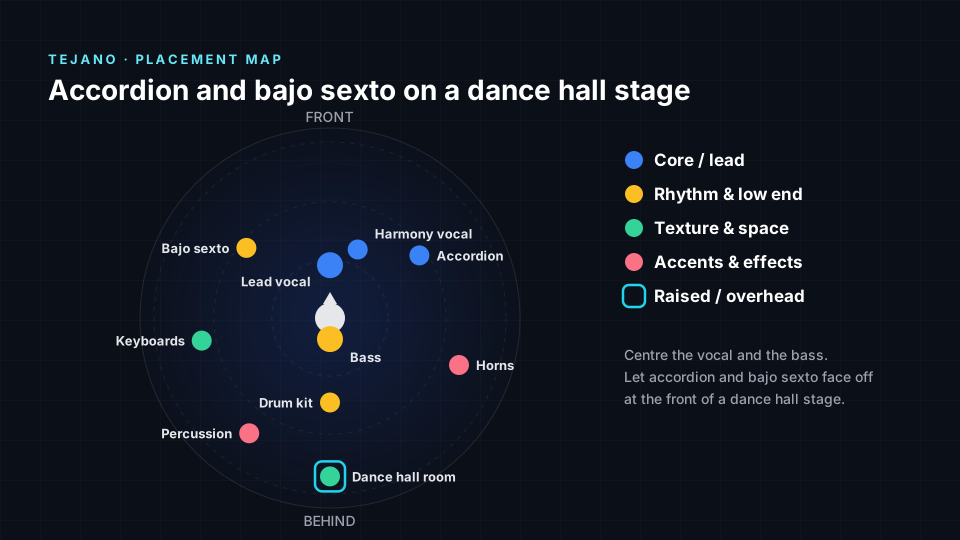
- In a spatial Tejano mix the lead vocal and the bass stay centred, while the button accordion and the bajo sexto face each other at the front and keyboards and horns fill the sides.
- Because the ear resolves front positions to about one degree, an effect known as the minimum audible angle, a small step forward is enough to bring the accordion out for its runs between verses.
- Tejano music is dance hall music, so the space should feel like a lively room with side reflections and a steady drum kit behind the band.
- The Tejano music immersion profile scores width 3, height 2, movement 2, low-end focus 3 and space 3 out of 5.
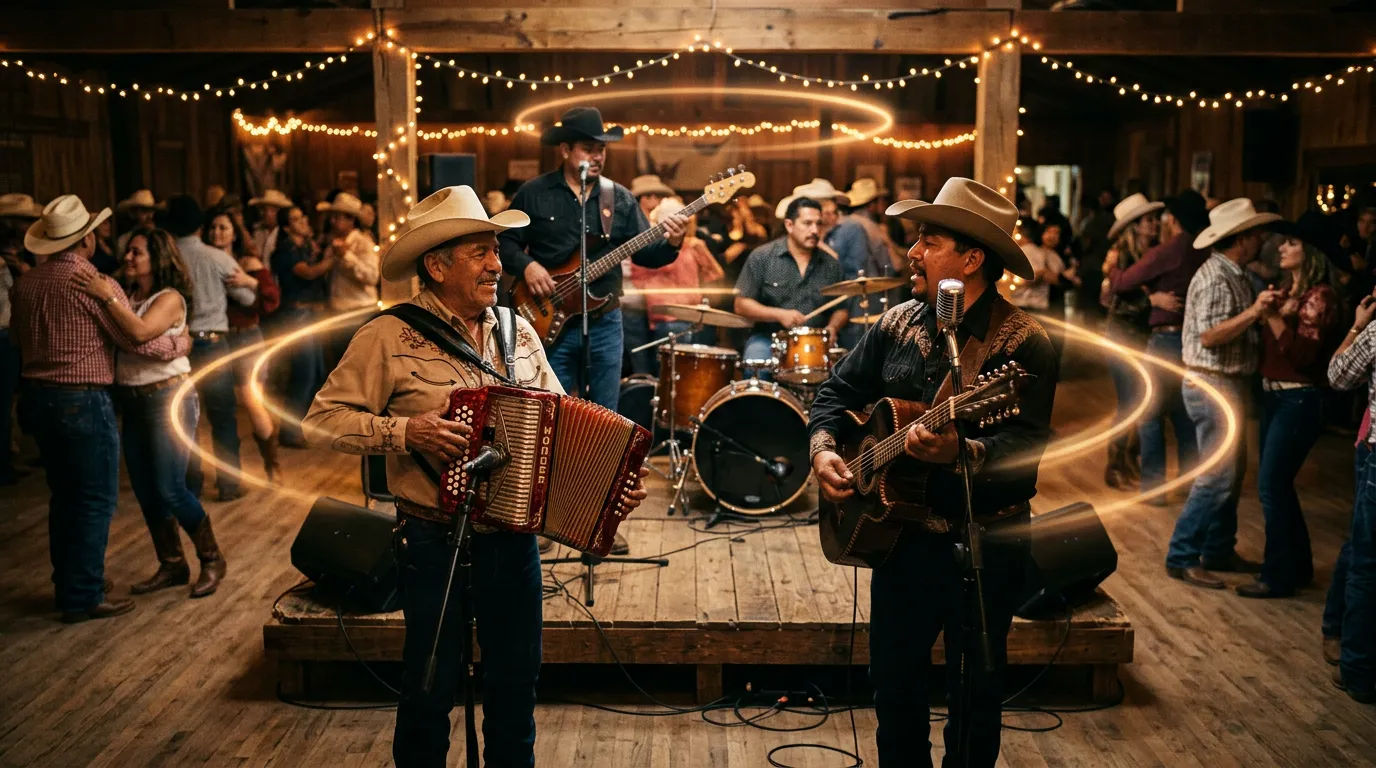
Tejano music is the popular music of the Mexican American communities of Texas. Its roots lie in the conjunto, which took shape in South Texas in the 1930s when musicians such as Narciso Martínez paired the button accordion, brought to the region by German and Czech settlers, with the bajo sexto, a twelve-string bass guitar from Mexico, often played by Santiago Almeida. Polkas, rancheras, redovas and waltzes made up the repertoire. By the 1950s drums and electric bass had joined, while larger orquesta tejana bands added horns. In the 1980s and 1990s Tejano became a radio and stadium music, with synthesizers, cumbia rhythms and stars such as Selena, La Mafia, Mazz and Emilio Navaira, and the Tejano Music Awards have run since 1981. Across the border, norteño from northern Mexico grew from the same accordion and bajo sexto pairing. Tejano music suits spatial audio because its two lead instruments play off each other like partners on a dance floor, and the dance hall around them is part of the sound. This guide covers how spatial audio for Tejano music works, where to place each element and how to make an immersive Tejano mix. For the basics, see what spatial audio is.
Why Tejano music works in spatial audio
Tejano music is built on a partnership. The accordion plays the melody, the fills and the fast runs between verses, while the bajo sexto strums and picks the bass and chords that lock it to the beat. The bass and drums keep a two-step or cumbia pulse for dancers, and keyboards or horns add colour in the modern sound. In stereo the accordion and bajo sexto often sit on top of the vocal in the middle. In an immersive mix the vocal and bass hold the centre, the accordion and bajo sexto face each other at the front, and the drums sit behind like they do on stage.
The rule: a centred voice and bass, accordion and bajo sexto facing each other up front. Keep the band in a stage line-up in front of the listener, let the accordion step forward a little for its runs, and set it all in a lively dance hall.
Immersive music for Tejano music: what listeners hear
- A singer right in front. The lead vocal sits in the centre, warm and clear, with the second voice of the classic duet just beside it.
- An accordion that steps out. The runs between verses move slightly forward, then fall back under the next line.
- Two partners at the front. The accordion on one side and the bajo sexto on the other, so the melody and the rhythm guitar never tangle.
- A dance hall around you. A lively room with side reflections places you on the floor of a Texas dance hall or a summer festival.
Where to place each element in a Tejano music mix
| Element | Position | Height | Why it works |
|---|---|---|---|
| Lead vocal | Front centre | Ear level | The lyric and the focus of every song |
| Bass | Centre | Ear level | The two-step or cumbia pulse for dancers |
| Harmony vocal | Front right of centre | Ear level | The second voice of the duet tradition |
| Accordion | Front right, stepping in for runs | Ear level | Melody, fills and fast runs between verses |
| Bajo sexto | Front left | Ear level | Strummed chords and picked bass lines |
| Drum kit | Centre, behind | Ear level | The steady beat at the back of the stage |
| Keyboards | Left | Ear level | Synth pads and organ in modern Tejano |
| Horns | Right | Ear level | Orquesta riffs and stabs |
| Percussion | Behind left | Ear level | Güiro and congas in Tejano cumbia |
| Dance hall room | Behind | Raised | A lively hall around the band |
The psychoacoustics behind Tejano music placement
Every position in the table above follows how the ear and brain locate sound. Here is the reason behind the main choices for Tejano music.
- Bass and kick stay centred. The ear finds almost no direction in frequencies below roughly 80 to 100 Hz, so the bass and the kick drum gain nothing from being spread and keep the dance pulse solid in the middle.
- Accordion and bajo sexto on opposite sides. The brain groups sounds into streams by pitch, timing and direction. This is auditory stream segregation (Bregman). The reedy accordion and the jangling bajo sexto share the mid range, and setting them apart lets the ear follow melody and rhythm as two parts.
- Small steps forward for the accordion runs. The ear can detect a change of only about one degree for sounds straight ahead. This is the minimum audible angle (Mills). A modest move toward the centre is enough to bring the runs out between verses.
- A dance hall with side reflections. Early reflections arriving from the sides make a sound feel wider and more enveloping. This is spatial impression from early lateral reflections (Barron and Marshall). A few side reflections give the band the feel of a busy hall without blurring the beat.
The immersion profile for Tejano music
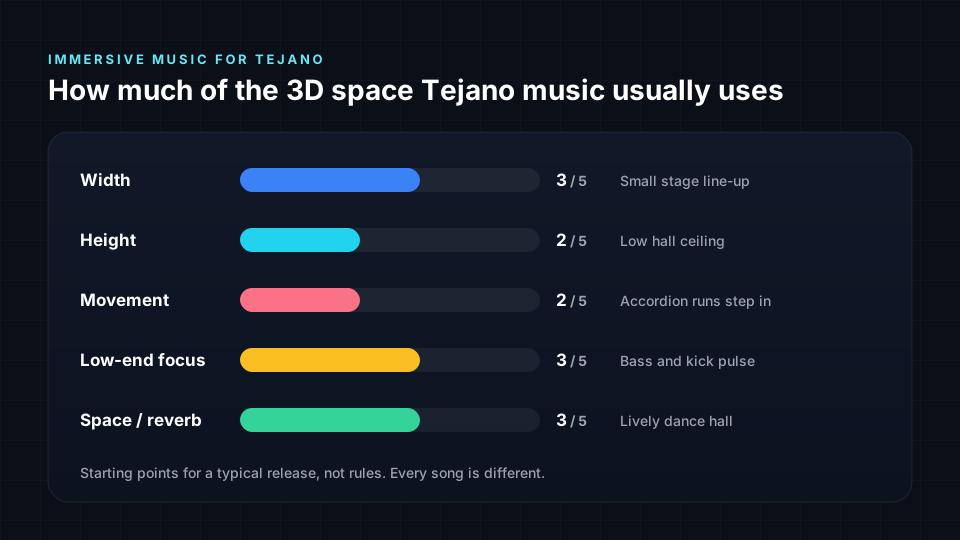
Width scores 3 because a conjunto or Tejano band plays as a compact line-up, not across a wide orchestral stage. Low-end focus is 3: bass and kick drive the dance floor, but the style never relies on sub bass. Space also scores 3, a lively hall that adds energy without washing out the accordion. Height is low, with only a light ceiling reflection. Movement scores 2, coming from the accordion stepping in for runs rather than sounds moving around the head.
Tips for an immersive Tejano music mix
- Keep the lead vocal front and centre. The song comes first, so the singer never moves.
- Face the accordion and bajo sexto across the front. Set them on opposite front sides so the melody and the rhythm stay clear.
- Put the drums behind the band. Keep the kit centred and slightly back, where it sits on a real stage.
- Keep the duet voices close. The second voice should blend with the lead, so place it just beside the centre.
- Use a lively hall, not a cathedral. A short, bright room suits dance music; long reverbs blur the accordion runs.
Tejano styles: conjunto, norteño and Tex-Mex
The core placement holds for every style here: voice and bass in the middle, accordion and bajo sexto at the front. What changes is the size of the band, the amount of electric and electronic sound and how much room the style needs.
Conjunto
Conjunto is the classic Texas-Mexican accordion band: button accordion, bajo sexto, bass and drums, playing polkas, rancheras and cumbias for dancers. Players such as Narciso Martínez, Valerio Longoria and Tony de la Rosa shaped the sound, and Esteban Jordan pushed the accordion further. Keep the four-piece line-up tight: accordion front right, bajo sexto front left, bass centred and drums behind. A small, lively hall suits the style, with no keyboards or horns.
Norteño
Norteño is the accordion music of northern Mexico, centred on Nuevo León, Tamaulipas and the border region. Groups such as Los Alegres de Terán, Ramón Ayala and Los Tigres del Norte made it one of the most popular sounds in Mexico and the United States, often singing corridos. The line-up mirrors conjunto, sometimes with saxophone. Keep the vocal duet close in the centre, accordion and bajo sexto on opposite front sides and any saxophone just to one side of the accordion.
Tex-Mex
Tex-Mex is the cross-border blend of conjunto with rock and roll, country and blues. Flaco Jiménez took the accordion into Americana, and the Texas Tornados, formed in 1989 with Doug Sahm, Augie Meyers, Freddy Fender and Flaco Jiménez, mixed Vox organ, guitar and accordion. This style can take a wider layout: keep the accordion and vocal at the front, place the organ and electric guitar at the sides and the drums behind. A roadhouse room with a little more reverb suits the sound.
Related styles such as orquesta tejana and Tejano cumbia follow the same idea: centre the voice and bass, then keep the lead instruments at the front of a dance hall stage.
Dolby Atmos and object-based mixing for tejano
Dolby Atmos mixes tejano music using a hybrid approach. It combines a traditional channel bed with audio objects that can be placed anywhere in the three-dimensional room. Most listeners will experience the mix on headphones through binaural rendering on services like Apple Music, Tidal and Amazon Music. Because Apple Music applies its own spatial renderer, the headphone result can differ from the Dolby binaural render and must be checked separately. Spatial9 helps you plan these placements to ensure your tejano mix translates perfectly across every format.

How the Atmos plan differs from the placement map. The Atmos plan differs from the Ambisonics map primarily in room depth. The map placed the drum kit and bass behind. In Atmos, we keep the main stage in front, so the drums and bass move to the front bed channels to drive the rhythm. The map also placed percussion behind left; we keep it slightly behind but raise it to add width without cluttering the ear-level stage. Low end stays in the bed.
Beds and objects for each tejano element
| Element | Atmos role | Where it plays in 7.1.4 | Binaural mode | Why |
|---|---|---|---|---|
| Lead vocal | Object | Ear level, front of the room, centre (X 0, Y 0.7, Z 0) | Near | Anchors the centre stage for focus and clarity. |
| Bass | Bed | Centre plus LFE (C + LFE) | Off | Bass and sub frequencies stay in the bed for a solid foundation. |
| Harmony vocal | Object | Ear level, front of the room, right (X 0.2, Y 0.7, Z 0) | Mid | Sits just beside the lead vocal to support the duet tradition. |
| Accordion | Object, small size, moving | Ear level, front of the room, right (X 0.4, Y 0.6, Z 0). Moving: Steps inward and forward for runs between verses, ending at ear level, front of the room, right | Mid | Pulls away from the rhythm guitar to keep melodies distinct. |
| Bajo sexto | Object, small size | Ear level, front of the room, left (X -0.4, Y 0.6, Z 0) | Mid | Mirrors the accordion to separate rhythm chords from the melody. |
| Drum kit | Bed | Front left and right (L/R) | Mid | A stereo bed anchors the drum kit firmly at the front. |
| Keyboards | Bed | Side surrounds (Lss/Rss) | Mid | Feeds the side channels to wrap modern synth pads around the band. |
| Horns | Object, medium size, moving | Ear level, front of the room, right (X 0.7, Y 0.4, Z 0). Moving: Pushes slightly up and wide during loud stabs, ending at ear level, front of the room, far right | Mid | Mirrors the keyboards to balance the modern orquesta tejana arrangement. |
| Percussion | Object, small size | Ear level, middle of the room, left (X -0.6, Y -0.2, Z 0.2) | Mid | Sits slightly behind and raised to add rhythmic width without clutter. |
Dolby Atmos settings for tejano
- LFE. The LFE channel exists only in the bed, so route the bass and kick here while relying on bass management for objects.
- Object size. Keep the lead vocal and accordion sizes small or point to maintain focus, while using medium for horns to spread them across more speakers.
- Height use. Reserve the height channels for ambience, reverb and occasional percussion accents to prevent the mix from losing focus on headphones.
- Binaural render. Set the lead vocal to near for intimacy, most instruments to mid, and ensure no metadata is left on off to avoid rejection by labels.
- Tejano balance. Mirror the accordion and bajo sexto left and right to keep the rhythm and melody distinct and the mix balanced.
Tejano across immersive formats
| Format | How it carries sound | What it means for tejano |
|---|---|---|
| Dolby Atmos | Hybrid: a 7.1.2 channel bed plus up to 118 objects placed with X, Y and Z metadata | Dolby Atmos combines a channel bed up to 7.1.2 with up to 118 objects to place tejano instruments precisely in the room. |
| Sony 360 Reality Audio | Object-based, built on MPEG-H 3D Audio: every sound is an object on a sphere | Sony 360 Reality Audio has no channel bed, so every tejano element becomes an object placed on a sphere around the listener. |
| MPEG-H 3D Audio | Channels, objects and Higher Order Ambisonics in one stream, with optional listener control | MPEG-H 3D Audio carries channels and objects, allowing listeners to adjust the level of the accordion or vocals if the producer allows it. |
| Auro-3D | Channel-based: a height layer above 5.1 or 7.1, with an optional overhead channel | Auro-3D uses fixed channels rather than objects, adding a height layer above the tejano band to capture the dance hall ambience. |
| Eclipsa Audio (IAMF) | Channel-based and scene-based (Ambisonics) audio elements; no objects | Eclipsa Audio uses IAMF, which lacks audio objects, so your tejano Atmos mix must be rendered to channels or Ambisonics for delivery. |
| Ambisonics | Scene-based: the whole sound field, decoded to any speaker layout or to headphones | Ambisonics stores the tejano sound field as spherical harmonics, decoding the stage layout to any speaker configuration or to headphones. |
| ADM BWF | Open exchange file (ITU-R BS.2076 metadata in a BW64 file) for channels, objects and scenes | The ADM BWF master file carries the open metadata for your tejano channels and objects to streaming services. |
Delivery checklist for a tejano Dolby Atmos release
- Master file. ADM BWF at 48 kHz and 24-bit, with no more than 128 channels: a 10-channel 7.1.2 bed plus up to 118 objects.
- Loudness. Integrated loudness no higher than -18 LKFS and true peak no higher than -1 dBTP, measured to ITU-R BS.1770.
- Binaural metadata. Set Off, Near, Mid or Far for every bed and object. Masters with everything left on Off are rejected.
- Re-renders. Listen to the 5.1, stereo and binaural re-renders before delivery, because most people will hear one of them.
Verify that the integrated loudness of your tejano mix does not exceed -18 LKFS and the true peak is no higher than -1 dBTP.
How to make immersive Tejano music from stereo
Spatial9 can create spatial audio from a stereo track in a few steps:
- Upload your stereo master or your stems.
- Spatial9's AI separates and places each part, pulling the vocal, accordion, bajo sexto, bass, drums and keyboards apart even from older recordings, and setting the accordion and bajo sexto across the front of a dance hall stage.
- Preview it in binaural on headphones.
- Export Eclipsa Audio, ADM, binaural or Ambisonics.
- Publish a video. Create a YouTube-ready video with your immersive audio and publish it directly.
For related guides, read spatial audio for regional Mexican music and spatial audio for cumbia. Every guide is listed in spatial audio and immersive music by genre.
Frequently asked questions
Does this guide cover conjunto, norteño and Tex-Mex?
Yes. Conjunto keeps a tight four-piece with accordion and bajo sexto at the front in a small hall. Norteño adds a close vocal duet and sometimes a saxophone. Tex-Mex takes a wider layout with organ and electric guitar at the sides.
Can I make a Tejano music mix in Dolby Atmos or Eclipsa Audio?
Yes, you can make a tejano mix in Dolby Atmos. You deliver an ADM BWF master file at 48 kHz and 24-bit to streaming services. Remember that Dolby Atmos and Eclipsa Audio are separate deliveries, as Eclipsa is built on IAMF and has no objects. You must also check your mix on Apple Music, because it applies its own spatial renderer that can sound different from the standard Dolby binaural headphone render.
Should tejano elements be beds or objects in Dolby Atmos?
Tejano elements should use a mix of both. The bass, kick drum and wide keyboards work best in the channel bed to provide a solid foundation and enveloping pads. The LFE channel only exists in the bed. The lead vocal, accordion, bajo sexto and horns should be objects. This allows you to pull them off the front wall for depth, separate the melody from the rhythm chords, and automate slight movements for the accordion runs.
Does a tejano Dolby Atmos mix also work for Sony 360 Reality Audio and MPEG-H?
A tejano Dolby Atmos mix does not translate directly to Sony 360 Reality Audio because Sony 360 has no channel bed. Every element must be placed as an object on a sphere. MPEG-H 3D Audio does carry both channels and objects, and it forms the basis of Sony 360. However, you will need to create separate exports and adjust your routing, as the formats handle metadata and listener interactivity differently than Dolby Atmos.
Is spatial audio good for Tejano music?
Yes. Tejano layers accordion, bajo sexto, vocals, bass and drums into one dense, mid-range band sound. Spatial audio gives each instrument its own direction, so the accordion runs and the lyrics both come through more clearly.
Where should the accordion go in an immersive Tejano mix?
Put it on one front side at ear level, opposite the bajo sexto, so the melody and the strum do not mask each other. Bring it slightly forward for intros and runs between verses.
How should I place the synths in 1990s Tejano?
Keep the keyboards to one side at ear level, opposite the horns if there are any, and slightly behind the accordion. Synth pads can spread a little wider, but the accordion should stay the lead at the front.
How is Tejano music different from country music in spatial audio?
Both are dance hall music, but Tejano centres on the accordion and bajo sexto partnership and often uses cumbia rhythms. Country leads with guitars, fiddle and steel guitar, so it needs a different front pairing and often a wider stage.
Can I convert an old conjunto recording to spatial audio?
Yes. Spatial9 uses AI to separate the vocal, accordion, bajo sexto and bass from a mono or stereo master. Separation is never perfect with older recordings, so keep the layout simple and close.
Dolby and Dolby Atmos are trademarks of Dolby Laboratories. 360 Reality Audio, Auro-3D and other format names are trademarks of their respective owners. Spatial9 is not affiliated with or endorsed by Dolby Laboratories or these companies.
Sources
- Blauert, J. (1997). Spatial Hearing: The Psychophysics of Human Sound Localization, revised edition. MIT Press. Low-frequency, elevation, distance and motion cues.
- Mills, A. W. (1958). On the minimum audible angle. Journal of the Acoustical Society of America, 30(4), 237-246.
- Hebrank, J. and Wright, D. (1974). Spectral cues used in the localization of sound sources on the median plane. Journal of the Acoustical Society of America, 56(6), 1829-1834.
- Bronkhorst, A. W. (2000). The cocktail party phenomenon: a review of research on speech intelligibility in multiple-talker conditions. Acta Acustica united with Acustica, 86, 117-128.
- Litovsky, R. Y., Colburn, H. S., Yost, W. A. and Guzman, S. J. (1999). The precedence effect. Journal of the Acoustical Society of America, 106(4), 1633-1654.
- Barron, M. and Marshall, A. H. (1981). Spatial impression due to early lateral reflections in concert halls. Journal of Sound and Vibration, 77(2), 211-232.
- Neuhoff, J. G. (1998). Perceptual bias for rising tones. Nature, 395, 123-124.
- Bregman, A. S. (1990). Auditory Scene Analysis: The Perceptual Organization of Sound. MIT Press.
- Peña, M. (1985). The Texas-Mexican Conjunto: History of a Working-Class Music. University of Texas Press.
- Dolby Laboratories. Dolby Atmos for content creators. Dolby Professional. professional.dolby.com. 7.1.2 bed, audio objects with X, Y, Z metadata and renderer re-renders.
- Production Expert. Mixing Dolby Atmos on headphones: a professional guide. production-expert.com. Binaural render modes Off, Near, Mid and Far.
- Universal Music Group. Content Guide: Dolby Atmos servicing asset specifications. contentguide.universalmusic.com. ADM BWF, 48 kHz, 24-bit, 128 channels, binaural metadata and -18 LKFS.
- International Telecommunication Union. Recommendation ITU-R BS.2076: Audio Definition Model.
- International Telecommunication Union. Recommendation ITU-R BS.2088: Long-form file format for the international exchange of audio programme materials with metadata (BW64).
- International Telecommunication Union. Recommendation ITU-R BS.2051: Advanced sound system for programme production.
- International Telecommunication Union. Recommendation ITU-R BS.1770: Algorithms to measure audio programme loudness and true-peak audio level.
- European Broadcasting Union. ADM related standards. adm.ebu.io.
- ISO/IEC 23008-3. Information technology. High efficiency coding and media delivery in heterogeneous environments. Part 3: 3D audio (MPEG-H 3D Audio).
- Herre, J., Hilpert, J., Kuntz, A. and Plogsties, J. (2015). MPEG-H 3D Audio: the new standard for coding of immersive spatial audio. IEEE Journal of Selected Topics in Signal Processing, 9(5), 770-779.
- Sony Corporation. 360 Reality Audio licensing. sony.co.jp. Object-based spatial audio based on MPEG-H 3D Audio.
- Alliance for Open Media. Immersive Audio Model and Formats (IAMF). aomediacodec.github.io/iamf. Channel-based and scene-based audio elements.
- Zotter, F. and Frank, M. (2019). Ambisonics: A Practical 3D Audio Theory for Recording, Studio Production, Sound Reinforcement, and Virtual Reality. Springer.
Take the floor
Upload a track to Spatial9 and hear the accordion and bajo sexto fill the dance hall around you in minutes. Then export it or publish it straight to YouTube.